CBSE Class 12 English - MCQ and Online Tests - Unit 8 - Going Places

CBSE Class 12 English – MCQ and Online Tests – Unit 8 – Going Places

Every year CBSE conducts board exams for 12th standard. These exams are very competitive to all the students. So our website provides online tests for all the 12th subjects. These tests are also very effective and useful for those who preparing for competitive exams like NEET, JEE, CA etc. It can boost their preparation level and confidence level by attempting these chapter wise online tests.

These online tests are based on latest CBSE Class 12 syllabus. While attempting these our students can identify the weak lessons and continuously practice those lessons for attaining high marks. It also helps to revise the NCERT textbooks thoroughly.


CBSE Class 12 English – MCQ and Online Tests – Unit 8 – Going Places

Question 1.
‘I wish he was an Englishman’. These words were spoken with reference to
(a) Geoff
(b) Derek
(c) Danny Casey
(d) a passenger in the bus

Answer

Answer: (d) a passenger in the bus


Question 2.
After describing Danny’s appearance, Sophie chose not to tell Geoff about
(a) Danny’s qualification
(b) Danny’s address
(c) his teeth
(d) his car

Answer

Answer: (c) his teeth


Question 3.
The match on Saturday was witnessed by
(a) the whole family
(b) only father and Sophie
(c) Geoff alone
(d) Sophie, father, Derek and Geoff

Answer

Answer: (d) Sophie, father, Derek and Geoff


Question 4.
When Sophie told her father that Danny had met her and told her that he was going to buy a shop, father
(a) called her a liar
(b) asked her if it was another of her wild stories
(c) disbelieved her outright
(d) asked Geoff to verify facts

Answer

Answer: (b) asked her if it was another of her wild stories


Question 5.
The father talked about a man who knew
(a) Pele
(b) Beckham
(c) Tom Finney
(d) Jeffrey, Archer

Answer

Answer: (c) Tom Finney


Question 6.
What does Geoff’s silence symbolise in Sophie’s view?
(a) distant places
(b) his vague personality
(c) his jovial nature
(d) wandering of his mind to distant places

Answer

Answer: (d) wandering of his mind to distant places


Question 7.
What did Sophie tell Geoff one day that made him look surprised?
(a) she had seen a ghost
(b) she had met her principal
(c) she had got a job
(d) she had met Danny Casey

Answer

Answer: (d) she had met Danny Casey


Question 8.
Danny had a freckled nose and the colour of his eyes was
(a) grey
(b) green
(c) blue
(d) brown

Answer

Answer: (b) green


Question 9.
She wanted to be a designer like
(a) Calvin Klein
(b) Versace
(c) Armani
(d) Mary Quant

Answer

Answer: (d) Mary Quant


Question 10.
Outside the pub, Sophie saw something. It was
(a) her dad’s bicycle
(b) her brother’s car
(c) her mother’s motorcycle
(d) Derek’s tricycle

Answer

Answer: (a) her dad’s bicycle


Question 11.
Danny Casey was a player in the football team of
(a) Ireland
(b) Finland
(c) England
(d) Denmark

Answer

Answer: (a) Ireland


Question 12.
Geoff never took Sophie out with him because he thought she was
(a) immature
(b) badly behaved
(c) too young
(d) too restless

Answer

Answer: (c) too young


Question 13.
While Sophie waited for Danny, she realized that
(a) Danny would come
(b) Danny would not come
(c) she was hungry
(d) she was thirsty

Answer

Answer: (b) Danny would not come


Question 14.
Sophie felt bad because of her brother
(a) never spoke much
(b) laughed a lot
(c) teased her a lot
(d) never took her out for dinner

Answer

Answer: (a) never spoke much


Question 15.
Geoff had been out of school for a period of
(a) three years
(b) five years
(c) one year
(d) two years

Answer

Answer: (a) three years


Question 16.
Sophie told Geoff that Danny was unable to sign an autograph for her because
(a) his secretary did not allow it
(b) he didn’t have paper or pen
(c) he said he’d do it later
(d) he was in a hurry to go home

Answer

Answer: (b) he didn’t have paper or pen


Question 17.
What was Sophie’s father keen to buy if Sophie ever came into money?
(a) a luxury car
(b) a decent house
(c) a yacht
(d) a shop

Answer

Answer: (b) a decent house


Question 18.
Sophie’s best friend was
(a) Derek
(b) Geoff
(c) Jansie
(d) Danny

Answer

Answer: (c) Jansie


Question 19.
Why does Sophie feel jealous of her brother?
(a) because he keeps silent
(b) because he is a mechanic
(c) because he reveals his secret
(d) because of inability to reach unknown areas of his mind

Answer

Answer: (d) because of inability to reach unknown areas of his mind


Question 20.
According to Sophie, the place she had chosen to meet Danny was
(a) a hidden alley
(b) a perfect place
(c) behind the walls
(d) near the trees

Answer

Answer: (b) a perfect place


Question 21.
Why does Sophie get angry with her brother?
(a) Because he revealed her secret to Jansie’s brother
(b) he doesn’t speak to her
(c) because of his silence
(d) none

Answer

Answer: (a) Because he revealed her secret to Jansie’s brother


Question 22.
Sophie told Jansie that her father if he got to know about her meeting with Danny would
(a) agree to their marriage
(b) murder her
(c) ask her to call him over for dinner
(d) ask to be introduced to him

Answer

Answer: (b) murder her


Question 23.
What kind of person is Sophie’s father ?
(a) a kind hearted
(b) a loving and caring
(c) a hard core realistic
(d) carefree

Answer

Answer: (c) a hard core realistic


Question 24.
Geoff had told about Sophie’s meeting with Danny Casey to
(a) the entire neighbourhood
(b) Frank
(c) Jansie
(d) the teachers in school

Answer

Answer: (b) Frank


Question 25.
Sophie’s dreams and disappointments are all in her mind?
(a) they all represent her imagination and nothing in reality
(b) they represent her nature
(c) they explain her personality
(d) they tell us her future

Answer

Answer: (a) they all represent her imagination and nothing in reality


CBSE Class 12 English - MCQ and Online Tests - Unit 7 - The Interview

CBSE Class 12 English – MCQ and Online Tests – Unit 7 – The Interview

Every year CBSE conducts board exams for 12th standard. These exams are very competitive to all the students. So our website provides online tests for all the 12th subjects. These tests are also very effective and useful for those who preparing for competitive exams like NEET, JEE, CA etc. It can boost their preparation level and confidence level by attempting these chapter wise online tests.

These online tests are based on latest CBSE Class 12 syllabus. While attempting these our students can identify the weak lessons and continuously practice those lessons for attaining high marks. It also helps to revise the NCERT textbooks thoroughly.


CBSE Class 12 English – MCQ and Online Tests – Unit 7 – The Interview

Question 1.
How many novels has Umberto written?
(a) 10
(b) 8
(c) 15
(d) 5

Answer

Answer: (d) 5


Question 2.
According to Umberto what will happen to the world if we eliminate empty spaces from the universe?
(a) The world will become beautiful
(b) The world will be completely ours
(c) The world will shrink and will become as big as a fish.
(d) The world will be round

Answer

Answer: (c) The world will shrink and will become as big as a fish.


Question 3.
What do his works for children speak about ?
(a) his passion for children
(b) children are nuisance
(c) children love to be happy
(d) non-violence and peace

Answer

Answer: (d) non-violence and peace


Question 4.
Who is the author of the lesson ‘The Interview’?
(a) Christopher Priest
(b) Christopher Silvester (1959)
(c) J.B. Priestley
(d) Alfred John Churchley

Answer

Answer: (b) Christopher Silvester (1959)


Question 5.
Explain ‘Denis Brain’s statement “Almost everything of moment reaches us through one man
asking questions of others.’
(a) The interviewer has the power
(b) The interviewer has status
(c) The interviewer can elicit the truth and has the power to influence
(d) All these

Answer

Answer: (d) All these


Question 6.
Enumerate ‘An Interview is a supremely serviceable medium of communication?
(a) a medium to gossip
(b) a medium to be the talk of the town
(c) a medium to prosper
(d) a noble medium of interaction and introspection

Answer

Answer: (d) a noble medium of interaction and introspection


Question 7.
What satisfied Umberto’s taste for narration?
(a) stories
(b) children’s works
(c) interviews
(d) Novels

Answer

Answer: (d) Novels


Question 8.
What do Rudyard Kipling and his wife express about interviews?
(a) immoral
(b) not good
(c) very bad
(d) immoral and offensive crime against a person

Answer

Answer: (d) immoral and offensive crime against a person


Question 9.
What do you understand by the expression ‘Thumbprints on his windpipes”?
(a) creating excessive pressure on throat
(b) creating excessive pressure on vocal chords
(c) creating excessive pressure and tension for someone
(d) none

Answer

Answer: (c) creating excessive pressure and tension for someone


Question 10.
What facts are being showcased in the interview held between Eco and Padamanabhan?
(a) he takes pride in being an academician, a university Professor first
(b) Being a novelist is a secondary thing for him
(c) uses his free time for writing novels
(d) All these

Answer

Answer: (d) All these


Question 11.
Why do the celebrities feel embarassed most often?
(a) because of question attacks during interviews
(b) because of interviewer’s gestures
(c) because of interviewer’s appearance
(d) none

Answer

Answer: (a) because of question attacks during interviews


Question 12.
Why were the journalists and publishers puzzled by the success of The Name of the Rose?
(a) because readers like trash and it was a serious novel
(b) because it was becoming popular
(c) because of its high rated success
(d) none

Answer

Answer: (a) because readers like trash and it was a serious novel


Question 13.
What was Lewis Caroll’s opinion of interviews and autographs?
(a) wonder
(b) terror
(c) horror
(d) none

Answer

Answer: (c) horror


Question 14.
What does Naipaul present in his travel books?
(a) his feelings
(b) his feelings about interviews
(c) impression of the country of his ancestors that is India
(d) none

Answer

Answer: (c) impression of the country of his ancestors that is India


Question 15.
At what age did he start writing novels?
(a) at the age of 55
(b) at the age of 52
(c) at the age of 57
(d) at the age of 50

Answer

Answer: (d) at the age of 50


Question 16.
Why do most celebrity writers despise being interviewed?
(a) they don’t like journalists
(b) unwarranted intrusion in their life
(c) their privacy is hurt
(d) none

Answer

Answer: (b) unwarranted intrusion in their life


Question 17.
What is the reason for huge success of the novel The Name of The Rose?
(a) mystic
(b) metaphysics and medieval history period used
(c) detective style and theology
(d) All these

Answer

Answer: (d) All these


Question 18.
Who has written Alice in Wonderland?
(a) Christopher
(b) Mukand
(c) Rudyard Kripling
(d) Lewis Caroll

Answer

Answer: (d) Lewis Caroll


Question 19.
Which period of history do Umberto’s novels deal with?
(a) Renaissance
(b) dark age
(c) modern era
(d) Medieval period

Answer

Answer: (d) Medieval period


Question 20.
How does Umberto Eco find so much time to write so much?
(a) using early morning time
(b) using his office time
(c) using his family time
(d) using empty spaces (free times) like waiting for someone, break time

Answer

Answer: (d) using empty spaces (free times) like waiting for someone, break time


Question 21.
Why did Umberto start writing novels?
(a) to avail an opportunity
(b) to be in limelight
(c) to share his views
(d) to make best use of empty spaces means free time

Answer

Answer: (d) to make best use of empty spaces means free time


Question 22.
What did he present in this book?
(a) varied opinions of politicians
(b) varied opinions of civilians
(c) varied opinions of armymen
(d) varied opinions of celebrities regarding an interview

Answer

Answer: (d) varied opinions of celebrities regarding an interview


Question 23.
What kind of a novel was The Name of The Rose?
(a) hilarious
(b) fiction
(c) non-fiction
(d) a serious one

Answer

Answer: (d) a serious one


Question 24.
In what way interviews have become a common place of journalism?
(a) because of its power, influence and medium of communication
(b) because of its pomp
(c) because of its glory
(d) because of its rapport

Answer

Answer: (a) because of its power, influence and medium of communication


Question 25.
Why does Eco call the success of his book a mystery?
(a) because of its success
(b) because of its popularity
(c) because of many factors
(d) because of many factors and many other books were written on the same medieval period

Answer

Answer: (d) because of many factors and many other books were written on the same medieval period


CBSE Class 12 English - MCQ and Online Tests - Unit 6 - Poets and Pancakes

CBSE Class 12 English – MCQ and Online Tests – Unit 6 – Poets and Pancakes

Every year CBSE conducts board exams for 12th standard. These exams are very competitive to all the students. So our website provides online tests for all the 12th subjects. These tests are also very effective and useful for those who preparing for competitive exams like NEET, JEE, CA etc. It can boost their preparation level and confidence level by attempting these chapter wise online tests.

These online tests are based on latest CBSE Class 12 syllabus. While attempting these our students can identify the weak lessons and continuously practice those lessons for attaining high marks. It also helps to revise the NCERT textbooks thoroughly.


CBSE Class 12 English – MCQ and Online Tests – Unit 6 – Poets and Pancakes

Question 1.
How many people were there in MRA group?
(a) 150
(b) 180
(c) 140
(d) 200 people from 20 nationalities

Answer

Answer: (d) 200 people from 20 nationalities


Question 2.
Why was Subbu considered number 2 at Gemini studio?
(a) because of his flattery
(b) because of his abilities
(c) because of creative skills
(d) none

Answer

Answer: (c) because of creative skills


Question 3.
Why was Subbu termed as ‘many sided genius’?
(a) his flattery
(b) gossip style
(c) interaction with others
(d) ability to create and manage things

Answer

Answer: (d) ability to create and manage things


Question 4.
The boy in the make up room was jealous of whom?
(a) actors
(b) author
(c) the visitor
(d) Subbu’s success and his closeness to the boss

Answer

Answer: (d) Subbu’s success and his closeness to the boss


Question 5.
Why was the author praying for crowd shooting at all times?
(a) to attract the crowd
(b) to avoid people
(c) to avoid epical narrations
(d) none

Answer

Answer: (c) to avoid epical narrations


Question 6.
Who was heading the make-up department?
(a) a Madrasi
(b) A tamilian
(c) A bengali
(d) A Bengali and later was succeeded by a Maharashtrian

Answer

Answer: (d) A Bengali and later was succeeded by a Maharashtrian


Question 7.
Why was Subbu a trouble shooter?
(a) because of his gossip style
(b) because of his flattery
(c) ability to mix up with everyone
(d) because of his problem resolving quality

Answer

Answer: (d) because of his problem resolving quality


Question 8.
Why did everybody in the studio think of giving some work to the author?
(a) because of the idle appearance of his work
(b) because he was an office boy
(c) because he was a helper
(d) none

Answer

Answer: (a) because of the idle appearance of his work


Question 9.
What is the example of National Integration in Poets and Pancakes?
(a) Make up department of Gemini
(b) rehersal room
(c) office of Gemini studio
(d) none

Answer

Answer: (a) Make up department of Gemini


Question 10.
What was MRA?
(a) British Army
(b) The Moral Rearmament Army- a counter movement to International Communism
(c) a wing of Indian Army
(d) A drama company

Answer

Answer: (b) The Moral Rearmament Army- a counter movement to International Communism


Question 11.
Who was the Englishman?
(a) Salman Rushdie
(b) D.H Lawrence
(c) George Orwell
(d) Stephen Spender- Editor of a British Periodical The Encounter

Answer

Answer: (d) Stephen Spender- Editor of a British Periodical The Encounter


Question 12.
When did MRA visit Madras?
(a) 1942
(b) 1922
(c) 1932
(d) 1952

Answer

Answer: (d) 1952


Question 13.
For whom was Gemini studio making films?
(a) for English people
(b) for illiterate
(c) for elderly peole
(d) for simple Tamilians who have no interest in English poetry

Answer

Answer: (d) for simple Tamilians who have no interest in English poetry


Question 14.
Who imitated the scenes of Sunset and Sunrise of Jotham Valley?
(a) Police
(b) Scouts of Madras
(c) Social Workers
(d) All Tamil Plays

Answer

Answer: (d) All Tamil Plays


Question 15.
Who was the founder of Gemini studio?
(a) Mr. S.S Vasan
(b) English man
(c) a Tamil boy
(d) a director

Answer

Answer: (a) Mr. S.S Vasan


Question 16.
Who was Greta Garbo?
(a) A Swedish actress- an Oscar winner
(b) a german actress
(c) a French actress
(d) a bengali actress

Answer

Answer: (a) A Swedish actress- an Oscar winner


Question 17.
How was Kothamanglam Subbu treated in the Gemini studio?
(a) with hatred
(b) rudely
(c) disrespectfully
(d) with high respect

Answer

Answer: (d) with high respect


Question 18.
Who is the author of Poets and Pancakes?
(a) Asokamitran (1931), a Tamil writer
(b) Charu Nivedita
(c) Jayakanthan
(d) Balakumaran

Answer

Answer: (a) Asokamitran (1931), a Tamil writer


Question 19.
In this lesson, what is the purpose of humor and satire used by the author?
(a) to highlight human abilities
(b) to show capabilities
(c) to show varied capacities
(d) to show and highlight human infancies and flaws

Answer

Answer: (d) to show and highlight human infancies and flaws


Question 20.
What has Asokamitran brought up through this write up?
(a) topics of film industry
(b) topics of make up industry
(c) topics of gossip
(d) topics of heroines

Answer

Answer: (a) topics of film industry


Question 21.
What does the expression ‘made to look ugly’ refer to ?
(a) make up done to look presentable before camera
(b) faces made by actors
(c) faces nade by office boy
(d) arrangements in the make up room

Answer

Answer: (a) make up done to look presentable before camera


Question 22.
How does the author come to know that English author was Stephen Spender?
(a) From a painting
(b) From the newspaper
(c) from a television show
(d) from a book- The God that failed

Answer

Answer: (d) from a book- The God that failed


Question 23.
What does the expression ‘ fiery misery’ mean?
(a) the glow of lights
(b) the bright lights
(c) the bright colorful dresses of heroines
(d) discomfort to the actors in the makeup room

Answer

Answer: (d) discomfort to the actors in the makeup room


Question 24.
When was Gemini studio set up?
(a) 1920
(b) 1930
(c) 1910
(d) 1940

Answer

Answer: (d) 1940


Question 25.
What things attracted the audience in the plays staged by MRA?
(a) their jewellery
(b) their make up
(c) their dialogues
(d) their sets and costumes

Answer

Answer: (d) their sets and costumes


CBSE Class 12 English - MCQ and Online Tests - Unit 5 - Indigo

CBSE Class 12 English – MCQ and Online Tests – Unit 5 – Indigo

Every year CBSE conducts board exams for 12th standard. These exams are very competitive to all the students. So our website provides online tests for all the 12th subjects. These tests are also very effective and useful for those who preparing for competitive exams like NEET, JEE, CA etc. It can boost their preparation level and confidence level by attempting these chapter wise online tests.

These online tests are based on latest CBSE Class 12 syllabus. While attempting these our students can identify the weak lessons and continuously practice those lessons for attaining high marks. It also helps to revise the NCERT textbooks thoroughly.


CBSE Class 12 English – MCQ and Online Tests – Unit 5 – Indigo

Question 1.
What was the attitude of the average Indian in smaller localities towards advocates of home rule?
(a) Very welcoming
(b) Very courageous
(c) Pleasing
(d) Very fearful and indifferent

Answer

Answer: (d) Very fearful and indifferent


Question 2.
Who were ready to follow Gandhi into jail?
(a) peasants
(b) lawyers
(c) Shukla
(d) J.B. Kriplani

Answer

Answer: (b) lawyers


Question 3.
The magistrate asked Gandhi to furnish bail for __ minutes
(a) 30
(b) 60
(c) 90
(d) 120

Answer

Answer: (d) 120


Question 4.
How did Gandhi behave with the officials outside the court?
(a) demonstrated his power
(b) was firm and resolute
(c) he said that he would disobey the order
(d) cooperated with them

Answer

Answer: (d) cooperated with them


Question 5.
Why did Gandhi start out on the back of an elephant?
(a) a peasant had been maltreated in a village nearby
(b) he set out to meet the secretary of British Landlords Association
(c) he set out to meet British official commissioner
(d) he was summoned by Sir Edward Gait, the Lt. Governor

Answer

Answer: (a) a peasant had been maltreated in a village nearby


Question 6.
Why did Gandhi consider the Champaran episode a turning point?
(a) Its voice spread far and wide
(b) It became famous
(c) The British were scared
(d) To protest the courts’ order to postpone the trial

Answer

Answer: (a) Its voice spread far and wide


Question 7.
Health conditions in Champaran
(a) miserable
(b) tolerable
(c) under control
(d) fairly good

Answer

Answer: (a) miserable


Question 8.
After Tirhut, where did Gandhi go?
(a) Lucknow
(b) Motihari
(c) Cawnpore
(d) Ahmedabad

Answer

Answer: (b) Motihari


Question 9.
What happened when Gandhi visited the secretary of British landlord’s association?
(a) the secretary proceeded to bully him
(b) the secretary advised him forthwith to leave Tirhut
(c) the secretary said that they could not give any information to an outsider
(d) the secretary was very helpful

Answer

Answer: (c) the secretary said that they could not give any information to an outsider


Question 10.
Why was Gandhi not permitted to draw water from Rajendra Prasad’s well?
(a) the servant thought Gandhi was another peasant
(b) as Rajendra Prasad was not at home
(c) Gandhi looked like a vagabond
(d) Gandhi was a Harijan

Answer

Answer: (a) the servant thought Gandhi was another peasant


Question 11.
What amount of repayment did the big planters think Gandhi would demand?
(a) repayment in full
(b) double the amount
(c) fifty percent of the amount
(d) no payment, just an apology

Answer

Answer: (a) repayment in full


Question 12.
Who volunteered to work in Champaran?
(a) two disciples of Gandhi and their wives
(b) Kasturba and the eldest son of Gandhi
(c) Mahadev Desai and his wife
(d) Narhari Prasad and his wife

Answer

Answer: (a) two disciples of Gandhi and their wives


Question 13.
Where is Champaran district situated?
(a) in the south-west of Orissa
(b) in the foothills of the Himalayas in Bihar
(c) in the northeast of Orissa
(d) in the south of Bihar

Answer

Answer: (b) in the foothills of the Himalayas in Bihar


Question 14.
What did the British landlords and from the peasants after synthetic indigo was developed?
(a) indigo as rent
(b) 15% of produce
(c) money as compensation
(d) a new settlement

Answer

Answer: (c) money as compensation


Question 15.
The representative of the planters offered to refund—– percent to the peasants
(a) 5
(b) 10
(c) 20
(d) 25

Answer

Answer: (d) 25


Question 16.
What were the places visited by Gandhi between his first meeting with Shukla and his arrival at Champaran?
(a) Cawnpore, Ahmedabad, Calcutta, Patna, Muzaffarpur
(b) Calcutta, Patna, Gaya, Muzaffarnagar
(c) Cawnpore, Ahmedabad, Gaya, Calcutta, Patna, Muzaffarpur
(d) Cawnpore, Ahmedabad, Patna and Muzaffarnagar

Answer

Answer: (a) Cawnpore, Ahmedabad, Calcutta, Patna, Muzaffarpur


Question 17.
What was the statement that Gandhiji read pleading himself guilty?
(a) That he was a law breaker
(b) That he wanted to command respect
(c) He was not a law breaker and came to render humanitarian and national service
(d) None

Answer

Answer: (c) He was not a law breaker and came to render humanitarian and national service


Question 18.
Who received Gandhi at the Muzaffarpur station?
(a) Shukla
(b) J.B Kriplani
(c) Rajendra Prasad
(d) Nehru

Answer

Answer: (b) J.B Kriplani


Question 19.
What was the condition of the peasants in Champaran?
(a) Very happy
(b) Independent
(c) Very rich
(d) Terror stricken and oppressed

Answer

Answer: (d) Terror stricken and oppressed


Question 20.
Shukla led Gandhi to the house of a lawyer who later became the President of India. He was
(a) J.B Kriplani
(b) Rajendra Prasad
(c) Zakir Hussain
(d) Mahadev Desai

Answer

Answer: (b) Rajendra Prasad


Question 21.
Gandhi was summoned by ___ the Lt. Governor
(a) Sir Edward Gait
(b) Sir Henry Gait
(c) Sir Richard Andrews
(d) Sir Freer Andrews

Answer

Answer: (a) Sir Edward Gait


Question 22.
What was the full name of the peasant from Champaran?
(a) J.B Shukla
(b) Rajkumar Shukla
(c) Ramkumar Shukla
(d) Roopkumar Shukla

Answer

Answer: (b) Rajkumar Shukla


Question 23.
For how long did Gandhi remain in Champaran?
(a) seven weeks
(b) three months
(c) one and a half year
(d) seven months

Answer

Answer: (d) seven months


Question 24.
When did Gandhiji go to Lucknow?
(a) December 1917
(b) October 1916
(c) February 1917
(d) December 1916

Answer

Answer: (d) December 1916


Question 25.
Where did Gandhiji stay for two days?
(a) At a peasant’s house
(b) At a lawyer’s house
(c) In a guest house
(d) At Prof. Malkani’s house

Answer

Answer: (d) At Prof. Malkani’s house


CBSE Class 12 English - MCQ and Online Tests - Unit 4 - The Rattrap

CBSE Class 12 English – MCQ and Online Tests – Unit 4 – The Rattrap

Every year CBSE conducts board exams for 12th standard. These exams are very competitive to all the students. So our website provides online tests for all the 12th subjects. These tests are also very effective and useful for those who preparing for competitive exams like NEET, JEE, CA etc. It can boost their preparation level and confidence level by attempting these chapter wise online tests.

These online tests are based on latest CBSE Class 12 syllabus. While attempting these our students can identify the weak lessons and continuously practice those lessons for attaining high marks. It also helps to revise the NCERT textbooks thoroughly.


CBSE Class 12 English – MCQ and Online Tests – Unit 4 – The Rattrap

Question 1.
When does the ironmaster realise his mistake?
(a) when the peddler speaks
(b) when he sees an old photograph
(c) when the peddler changes clothes and cleans his face
(d) All of these

Answer

Answer: (c) when the peddler changes clothes and cleans his face


Question 2.
The first move of the ironmaster was to make sure that the guest could
(a) gain some flesh on his bones
(b) have verification done
(c) be given some money
(d) be given some clothes

Answer

Answer: (a) gain some flesh on his bones


Question 3.
The girl had brought with her the following article to make him feel warm
(a) A blanket
(b) A woollen shawl
(c) A sweater
(d) A fur coat

Answer

Answer: (d) A fur coat


Question 4.
The purpose of her visit to the iron-mill was to
(a) persuade the rattrap seller to spend Christmas Eve at their house
(b) propose to him
(c) counsel him
(d) advise him to give up stealing

Answer

Answer: (a) persuade the rattrap seller to spend Christmas Eve at their house


Question 5.
The name of the ironmaster’s daughter was
(a) Emily Dickinson
(b) Edla Willmansson
(c) Sophia Loren
(d) Mary

Answer

Answer: (b) Edla Willmansson


Question 6.
How much money had the peddler stolen from Crofter?
(a) 20 kronors
(b) 10 kronors
(c) 40 kronors
(d) 30 kronors

Answer

Answer: (d) 30 kronors


Question 7.
The ironmaster lived in the manor with his
(a) sons
(b) wife
(c) oldest daughter
(d) old mother

Answer

Answer: (c) oldest daughter


Question 8.
The ironmaster mistook the rattrap peddler for
(a) an old regimental comrade
(b) an old servant
(c) an old employee
(d) an old cousin of his wife

Answer

Answer: (a) an old regimental comrade


Question 9.
The peddler entered the gate of the iron mill with the intention of
(a) asking for food
(b) meeting the master smith
(c) shelter from rain and cold
(d) chatting with his friends

Answer

Answer: (c) shelter from rain and cold


Question 10.
What did the ironmaster feel when he saw the rattrap seller after he was well groomed by his valet?
(a) Not pleased
(b) Very happy
(c) Suspicious
(d) Angry

Answer

Answer: (a) Not pleased


Question 11.
He felt he had been fooled by a
(a) prankster
(b) bait
(c) crofter
(d) policeman

Answer

Answer: (b) bait


Question 12.
How did Crofter treat the Peddler?
(a) Very rudely
(b) In a strange manner
(c) Friendly manner
(d) None of these

Answer

Answer: (c) Friendly manner


Question 13.
The rattrap peddler gave the ironmaster a lecture on
(a) how the world is a rat trap
(b) how to be honest
(c) how to be ethically correct
(d) how to be professional

Answer

Answer: (a) how the world is a rat trap


Question 14.
The stranger’s reaction to the ironmaster was
(a) he made no attempt to hide his feelings
(b) he was angry
(c) he denied it completely
(d) he started screaming

Answer

Answer: (a) he made no attempt to hide his feelings


Question 15.
The rattrap peddler returned to the man’s house in order to
(a) steal the thirty kroner
(b) say thanks to the old man
(c) take the bag he had left behind
(d) note down the address of the old man

Answer

Answer: (a) steal the thirty kroner


Question 16.
The rattrap peddler spent most of his Christmas Eve
(a) laughing
(b) singing
(c) playing
(d) sleeping

Answer

Answer: (d) sleeping


Question 17.
The crofter had received a payment of
(a) forty kroner
(b) thirty kroner
(c) twenty-five kroner
(d) ten kroner

Answer

Answer: (b) thirty kroner


Question 18.
The old man was very generous with his
(a) confidence
(b) money
(c) food
(d) guest

Answer

Answer: (a) confidence


Question 19.
What did the package left for Edla contain?
(a) a small rattrap with 30 kroner on it
(b) a small bangle
(c) a necklace
(d) a diamond ring

Answer

Answer: (a) a small rattrap with 30 kroner on it


Question 20.
The old man in the grey cottage
(a) welcomed the peddler
(b) shooed away the peddler
(c) fought with the peddler
(d) got into an argument

Answer

Answer: (a) welcomed the peddler


Question 21.
What was the Peddler’s profession and who he was?
(a) Selling, traveller
(b) Begging, traveller
(c) Stealing, thief
(d) None of these

Answer

Answer: (c) Stealing, thief


Question 22.
The vagabond compared the whole world to a
(a) planet
(b) universe
(c) space
(d) rattrap

Answer

Answer: (d) rattrap


Question 23.
What did the ironmaster’s daughter say when the peddler was about to leave?
(a) she asked him to stay for that day only
(b) she said she wanted to go with him
(c) she told him not to mind what her father had said
(d) she asked him to leave after 2 days

Answer

Answer: (a) she asked him to stay for that day only


Question 24.
The peddler’s rattraps were made of
(a) wood
(b) aluminium
(c) wire
(d) plastic

Answer

Answer: (c) wire


Question 25.
How did the Crofter tempt the Peddler to steal his money?
(a) By his kindness
(b) By his warm care
(c) By showing him money
(d) None of these

Answer

Answer: (c) By showing him money


CBSE Class 12 English - MCQ and Online Tests - Unit 3 - Deep Water

CBSE Class 12 English – MCQ and Online Tests – Unit 3 – Deep Water

Every year CBSE conducts board exams for 12th standard. These exams are very competitive to all the students. So our website provides online tests for all the 12th subjects. These tests are also very effective and useful for those who preparing for competitive exams like NEET, JEE, CA etc. It can boost their preparation level and confidence level by attempting these chapter wise online tests.

These online tests are based on latest CBSE Class 12 syllabus. While attempting these our students can identify the weak lessons and continuously practice those lessons for attaining high marks. It also helps to revise the NCERT textbooks thoroughly.


CBSE Class 12 English – MCQ and Online Tests – Unit 3 – Deep Water

Question 1.
After being haunted by fear for many years Douglas decided to learn to swim. He took the help of
(a) his mother
(b) his father
(c) a friend
(d) an instructor

Answer

Answer: (d) an instructor


Question 2.
When he regained consciousness, he
(a) laughed at his experience
(b) had 104° F fever
(c) shook and cried and didn’t eat anything
(d) told his mother about his misadventure

Answer

Answer: (c) shook and cried and didn’t eat anything


Question 3.
Douglas went down towards the bottom
(a) only once
(b) twice
(c) thrice
(d) five times

Answer

Answer: (c) thrice


Question 4.
William Douglas was a friend and adviser of
(a) President Kennedy
(b) President Cleveland
(c) President Roosevelt
(d) President Clinton

Answer

Answer: (c) President Roosevelt


Question 5.
The water in the pool had a
(a) dirty yellow tinge
(b) a blue reflection
(c) green colour
(d) no colour

Answer

Answer: (a) dirty yellow tinge


Question 6.
At the end of the experience, Douglas felt
(a) happy
(b) released
(c) sad
(d) victorious

Answer

Answer: (b) released


Question 7.
When Douglas tried to yell
(a) everyone came to his rescue
(b) no sound came out
(c) his father arrived
(d) the lifeguard dived to save him up, they hung as

Answer

Answer: (b) no sound came out


Question 8.
The writer decided to learn to swim when he was about
(a) ten or eleven years old
(b) fifteen or sixteen years old
(c) twenty years old
(d) eighteen years old

Answer

Answer: (a) ten or eleven years old


Question 9.
The nine feet seemed to Douglas like
(a) hundred feet
(b) ninety feet
(c) fifty feet
(d) twenty-five feet

Answer

Answer: (b) ninety feet


Question 10.
Though Douglas was frightened, he was not
(a) afraid to die
(b) going to survive
(c) out of his wits
(d) able to shout for help

Answer

Answer: (c) out of his wits


Question 11.
Douglas had to repeat exhaling and inhaling exercises
(a) hundred times
(b) forty times
(c) fifty times
(d) ten times

Answer

Answer: (a) hundred times


Question 12.
He practised in the pool
(a) ten times a week
(b) five days a week
(c) twice a week
(d) thrice a week

Answer

Answer: (b) five days a week


Question 13.
Douglas calls him a
(a) nasty human being
(b) a brute
(c) a beautiful physical specimen
(d) a big bully

Answer

Answer: (c) a beautiful physical specimen


Question 14.
‘What do you think you can do to me’? These words were spoken by Douglas to
(a) a shark
(b) to his enemy
(c) to the boy who pushed him
(d) to terror

Answer

Answer: (d) to terror


Question 15.
The misadventure at the Y.M.C.A pool happened when
(a) Douglas was accompanied by friends
(b) he was with his father
(c) he was alone
(d) he was with his mother

Answer

Answer: (c) he was alone


Question 16.
‘All we have to fear is fear itself. Who said these words?
(a) Douglas
(b) his instructor
(c) his father
(d) President Roosevelt

Answer

Answer: (d) President Roosevelt


Question 17.
The incident in childhood had taken place at the beach in
(a) Florida
(b) Washington
(c) New York
(d) California

Answer

Answer: (d) California


Question 18.
Whenever terror struck again, Douglas would start
(a) shouting
(b) laughing
(c) crying
(d) talking to terror

Answer

Answer: (d) talking to terror


Question 19.
The pool’s depth at the deep end was
(a) twenty feet
(b) nine feet
(c) six feet
(d) eight feet

Answer

Answer: (b) nine feet


Question 20.
His mother warned him against swimming in the Yakima River because it had
(a) strong currents
(b) it was meant only for boating
(c) many people had drowned there
(d) it had no lifeguards around

Answer

Answer: (c) many people had drowned there


CBSE Class 12 English - MCQ and Online Tests - Unit 2 - Lost Spring

CBSE Class 12 English – MCQ and Online Tests – Unit 2 – Lost Spring

Every year CBSE conducts board exams for 12th standard. These exams are very competitive to all the students. So our website provides online tests for all the 12th subjects. These tests are also very effective and useful for those who preparing for competitive exams like NEET, JEE, CA etc. It can boost their preparation level and confidence level by attempting these chapter wise online tests.

These online tests are based on latest CBSE Class 12 syllabus. While attempting these our students can identify the weak lessons and continuously practice those lessons for attaining high marks. It also helps to revise the NCERT textbooks thoroughly.


CBSE Class 12 English – MCQ and Online Tests – Unit 2 – Lost Spring

Question 1.
If laws were to be enforced, it would bring about change and relief in the lives of about
(a) ten thousand children
(b) twenty thousand children
(c) hundred children
(d) a thousand children

Answer

Answer: (b) twenty thousand children


Question 2.
Bangle industry flourishes in the town of
(a) Ferozepur
(b) Firozabad
(c) Ferozgarh
(d) Farukhabad

Answer

Answer: (b) Firozabad


Question 3.
Mukesh belonged to a family of
(a) farmers
(b) rag-pickers
(c) bangle makers
(d) motor mechanics

Answer

Answer: (c) bangle makers


Question 4.
“One wonders if he has achieved what many have failed to achieve in their lifetime. He has a roof over his head”; these lines were said in reference to the condition of
(a) the elderly woman’s old husband
(b) Mukesh’s father
(c) the bangle factory owner
(d) Mukesh’s elder brother

Answer

Answer: (a) the elderly woman’s old husband


Question 5.
One day, Saheb was seen by the author, watching some young men playing
(a) cricket
(b) tennis
(c) hockey
(d) soccer

Answer

Answer: (b) tennis


Question 6.
According to the author, rag picking has become, over the years, a
(a) profession
(b) fine art
(c) tradition
(d) culture

Answer

Answer: (b) fine art


Question 7.
’Why do you do this?’ This question was asked by the author to
(a) the bangle sellers
(b) Mahesh
(c) Saheb
(d) Saheb’s mother

Answer

Answer: (c) Saheb


Question 8.
The rag pickers have no identity, but they have
(a) permits
(b) passports
(c) ration cards
(d) licenses

Answer

Answer: (a) permits


Question 9.
Mukesh wants to learn to become a motor mechanic by
(a) finding a tutor
(b) going to a garage to learn
(c) by reading books
(d) by joining a school

Answer

Answer: (b) going to a garage to learn


Question 10.
The colony of ragpickers is situated in
(a) the south of Delhi
(b) Mongolpuri
(c) Jehangirpuri
(d) Seemapuri

Answer

Answer: (d) Seemapuri


Question 11.
Which of the objects below best serves as a symbol of an Indian woman’s `suhag’?
(a) bindi
(b) sindoor
(c) bangles
(d) henna-dyed hands

Answer

Answer: (c) bangles


Question 12.
The frail woman in Mukesh’s house is his
(a) mother
(b) elder brother’s wife
(c) wife
(d) niece

Answer

Answer: (b) elder brother’s wife


Question 13.
What did the man from Udipi pray for, when he was young?
(a) a pair of trousers
(b) a pair of shoes
(c) a few friends
(d) an opportunity to study in a school

Answer

Answer: (b) a pair of shoes


Question 14.
What bothers the author most about the bangle makers?
(a) the stigma of poverty and caste
(b) the affluence of the landlords
(c) the behaviour of the factory owners
(d) the labour laws

Answer

Answer: (a) the stigma of poverty and caste


Question 15.
One explanation which the author gets about children choosing to remain barefoot is
(a) they have no money
(b) tradition
(c) no matching pairs
(d) like to wear only chappals

Answer

Answer: (b) tradition


Question 16.
‘Is your school ready? Who asked this question?
(a) Saheb’s mother
(b) Saheb’s friends
(c) the author
(d) Saheb

Answer

Answer: (d) Saheb


Question 17.
What were Saheb and his family looking for in Delhi?
(a) dollars
(b) rupees
(c) pounds
(d) gold

Answer

Answer: (d) gold


Question 18.
Sunny-gold, paddy green, royal blue, pink, purple, every colour born out of the seven colours of the rainbow. What is this a reference to?
(a) clothes
(b) birds
(c) bangles
(d) bindis

Answer

Answer: (c) bangles


Question 19.
Saheb’s home, before Delhi, was in
(a) Bengal
(b) Orissa
(c) Dhaka
(d) Bihar

Answer

Answer: (c) Dhaka


Question 20.
What was the profession of Mukesh’s father before he became a bangle-maker?
(a) tailor
(b) carpenter
(c) plumber
(d) Mason

Answer

Answer: (a) tailor


CBSE Class 12 English - MCQ and Online Tests - Unit 1 - The Last Lesson

CBSE Class 12 English – MCQ and Online Tests – Unit 1 – The Last Lesson

Every year CBSE conducts board exams for 12th standard. These exams are very competitive to all the students. So our website provides online tests for all the 12th subjects. These tests are also very effective and useful for those who preparing for competitive exams like NEET, JEE, CA etc. It can boost their preparation level and confidence level by attempting these chapter wise online tests.

These online tests are based on latest CBSE Class 12 syllabus. While attempting these our students can identify the weak lessons and continuously practice those lessons for attaining high marks. It also helps to revise the NCERT textbooks thoroughly.


CBSE Class 12 English – MCQ and Online Tests – Unit 1 – The Last Lesson

Question 1.
Why was Franz surprised?
(a) Because of village elders
(b) Because of police patrolling
(c) because of students’ behavior
(d) because of M.Hamel’s kind and polite behaviour

Answer

Answer: (d) because of M.Hamel’s kind and polite behaviour


Question 2.
What is the moral that the Alphonse Daudet wants to bring out?
(a) not to put off things that one can do that day
(b) old order changed to new
(c) one should accept everything that happens
(d) teachers should be respected

Answer

Answer: (a) not to put off things that one can do that day


Question 3.
What was Franz banking on to enter the class as he was late?
(a) M.Hamel’s teaching on the blackboard
(b) commotion in the class
(c) Hauser helping him sneak in
(d) to quietly walk in when everyone was preoccupied with participles

Answer

Answer: (b) commotion in the class


Question 4.
Why did Hamel blame himself?
(a) not having taught them enough French
(b) not being strict
(c) giving students a holiday at times
(d) not being responsible

Answer

Answer: (c) giving students a holiday at times


Question 5.
Who sat on the back bench on the last lesson?
(a) Franz
(b) Prussians
(c) the village people
(d) The new teacher

Answer

Answer: (c) the village people


Question 6.
M. Hamel is introduced as a ruler-wielding teacher. This demonstrates that:
(a) he is concerned.
(b) he is adamant.
(c) he is unfeeling.
(d) he is a hard taskmaster.

Answer

Answer: (d) he is a hard taskmaster.


Question 7.
What was M. Hamel going to question Franz about?
(a) participles
(b) adjectives
(c) old primer
(d) Ba be bi bo bu

Answer

Answer: (a) participles


Question 8.
What was Franz expected to be prepared for at school that day?
(a) song
(b) dance
(c) essay writing
(d) Participles

Answer

Answer: (d) Participles


Question 9.
For the last two years, where did all the bad news come from?
(a) the Bulletin Board
(b) Town Hall
(c) school
(d) M. Hamel’s House

Answer

Answer: (a) the Bulletin Board


Question 10.
Franz thinks- will they make them sing in German- even the pigeons? What could this mean?
(a) German would use brutal force over everyone
(b) harsh orders will be passed
(c) when people are deprived of their essence even the surroundings are affected.
(d) the Germans will rob France of its language.

Answer

Answer: (c) when people are deprived of their essence even the surroundings are affected.


Question 11.
Don’t go so fast, you will get to your school in plenty of time means ___
(a) getting late
(b) very early
(c) not early
(d) early enough

Answer

Answer: (d) early enough


Question 12.
What does M. Hamel’s motionless posture reflect?
(a) the school is dismissed
(b) sense of finality
(c) changing order of life
(d) feeling of nostalgia

Answer

Answer: (b) sense of finality


Question 13.
What did Mr. Hamel bring for his class on his last day in the school?
(a) new pens
(b) new notebooks
(c) sweets
(d) story books

Answer

Answer: (b) new notebooks


Question 14.
Franz looked for opportunities to skip school to do what?
(a) work on mills
(b) go fishing
(c) water the plants
(d) collect birds eggs

Answer

Answer: (d) collect birds eggs


Question 15.
Why did the villagers come to meet M. Hamel in the school?
(a) to complain
(b) to say goodbye
(c) to gossip
(d) to show gratitude

Answer

Answer: (d) to show gratitude


CBSE Class 12 Accountancy - MCQ and Online Tests - Unit 11 - Cash Flow Statement

CBSE Class 12 Accountancy – MCQ and Online Tests – Unit 11 – Cash Flow Statement

Every year CBSE conducts board exams for 12th standard. These exams are very competitive to all the students. So our website provides online tests for all the 12th subjects. These tests are also very effective and useful for those who preparing for competitive exams like NEET, JEE, CA etc. It can boost their preparation level and confidence level by attempting these chapter wise online tests.

These online tests are based on latest CBSE Class 12 syllabus. While attempting these our students can identify the weak lessons and continuously practice those lessons for attaining high marks. It also helps to revise the NCERT textbooks thoroughly.


CBSE Class 12 Accountancy – MCQ and Online Tests – Unit 11 – Cash Flow Statement

Question 1.
If net profit is 7 50,000 after writing off goodwill 7 10,000 then the cash flow from operating activities will be:
(a) ₹ 60,000
(b) ₹ 40,000
(c) ₹ 50,000
(d) ₹ 30,000

Answer

Answer: (a) ₹ 60,000


Question 2.
Which of the following is an example of Cash Flow from Operating Activities ?
(a) Purchase of Machinery
(b) Issue of Shares
(c) Purchases of Inventory for Cash
(d) Purchases of Investment

Answer

Answer: (c) Purchases of Inventory for Cash


Question 3.
Cash sales in :
(a) Operating Activity
(b) Investing Activity
(c) Financing Activity
(d) None of these

Answer

Answer: (a) Operating Activity


Question 4.
Issue of shares in consideration of purchase of plant and machinery results into :
(a) Inflow of Cash
(b) Outflow of Cash
(c) Neither Inflow nor Outflow
(d) None of these

Answer

Answer: (c) Neither Inflow nor Outflow


Question 5.
Decrease in Current Asset is……….in operating profit
(a) Subtracted
(b) Added
(c) Divided
(d) Multiplied

Answer

Answer: (b) Added


Question 6.
Cash from operating activities will decrease due to :
(a) Increase in Current Assets
(b) Decrease in Current Liabilities
(c) Neither of the two
(d) Both (a) and (b)

Answer

Answer: (d) Both (a) and (b)


Question 7.
While calculating operating profit which will be added to net profit:
(a) Interest received
(b) Profit on sale of Asset
(c) Increase in General Reserve
(d) Refund of Tax

Answer

Answer: (c) Increase in General Reserve


Question 8.
Preparation of cash flow statement is :
(a) Mendatory
(b) Recommendatory
(c) Required under the Companies Act
(d) None of these

Answer

Answer: (a) Mendatory


Question 9.
While calculating cash flow from operating netivities which will be deducted ?
(a) Increase in Creditors
(b) Increase in Debtors
(c) Decrease in Debtors
(d) Decrease in Prepaid Expenses

Answer

Answer: (b) Increase in Debtors


Question 10.
While calculating cash flow from operating activities, which will be added ?
(a) Increase in Stock
(b) Increase in Creditors
(c) Decrease in Bills Payable
(d) Increase in Debtors

Answer

Answer: (b) Increase in Creditors


Question 11.
An example of Cash Flows from Financing Activity is :
(a) Sale of goods
(b) Sale of Investment
(c) Cash receipts from issue of shares
(d) Interest received

Answer

Answer: (c) Cash receipts from issue of shares


Question 12.
How will you treat payment of ‘Interest of Debentures’ while preparing a Cash Flow Statement ?
(a) Cash Flow from Operating Activities
(b) Cash Flow from Investing Activities
(c) Cash Flow from Financing Activities
(d) Cash Equivalents

Answer

Answer: (c) Cash Flow from Financing Activities


Question 13.
Cash payment to employees is a Cash Flow from:
(a) Operating Activities
(b) Investing Activities
(c) Finance Activities
(d) All the above

Answer

Answer: (a) Operating Activities


Question 14.
Where will you show purchase of goodwill in Cash Flow Statement:
(a) Cash Flow from Operating Activities
(b) Cash Flow from Investing Activities
(c) Cash Flow from Financing Activities
(d) Cash Equivalent

Answer

Answer: (b) Cash Flow from Investing Activities


Question 15.
An example of Cash Flow from Investing Activities :
(a) Cash Sales
(b) Issue of Shares
(c) Payment of cash for purchase of machinery
(d) Payment of Dividend

Answer

Answer: (c) Payment of cash for purchase of machinery


Question 16.
Interest received by a finance company is classified under which kind of activity while preparing a Cash Flow Statement ?
(a) Cash Flow from Operating Activities
(b) Investing Activities
(c) Financing Activities
(d) Cash Equivalent

Answer

Answer: (a) Cash Flow from Operating Activities


Question 17.
Which of the following item is not considered as cash equivalents ?
(a) Bank Overdraft
(b) Commercial Papers
(c) Treasury Bills
(d) Investment

Answer

Answer: (d) Investment


Question 18.
Which of the following is not a Cash in Flow ?
(a) Sale of Fixed Asset
(b) Purchase of Fixed Asset
(c) Issue of Debentures
(d) Sale of Goods for Cash

Answer

Answer: (b) Purchase of Fixed Asset


Question 19.
In cash flow statement, the item of ‘Interest’ is shown in:
(a) Operating Activities
(b) Investing Activities
(c) Financial Activities
(d) In both (d) & (c)

Answer

Answer: (d) In both (d) & (c)


Question 20.
Which of the following is not a Cash Outflow:
(a) Increase in Creditors
(b) Increase in Debtors
(c) Increase in Stock
(d) Increase in prepaid expenses

Answer

Answer: (a) Increase in Creditors


Question 21.
If net profit is ₹ 35,000 after writing off good will ₹ 6,000 and loss on sale of furniture ₹ 1,000, cash flow from operating activities will be :
(a) ₹ 35,000
(b) ₹ 42,000
(c) ₹ 29,000
(d) ₹ 28,000

Answer

Answer: (b) ₹ 42,000


Question 22.
Income tax refund is a cash of:
(a) Source
(b) Application
(c) Both (a) & (b)
(d) None of these

Answer

Answer: (a) Source


Question 23.
Cash Flow Statement is prepared from:
(a) Balance Sheet
(b) Profit & Loss Account
(c) Additional Information
(d) All of these

Answer

Answer: (d) All of these


Question 24.
Cash Flow Statement in based upon:
(a) Cash basis of accounting
(b) Accrual basis of accounting
(c) (a) and (b) both
(d) None of these

Answer

Answer: (a) Cash basis of accounting


Question 25.
Which of the following is not a cash inflow ?
(a) Decrease in Debtors
(b) Issue of Debentures
(c) Decrease in Creditors
(d) None of these

Answer

Answer: (c) Decrease in Creditors


Question 26.
Cash from operation is equal to :
(a) Net Profit + Increase in Current Assets
(b) Net Profit + Decrease in Current Liabilities
(c) Operating Profit + Adjustment of Current Assets and Current Liabilities
(d) All of the above

Answer

Answer: (b) Net Profit + Decrease in Current Liabilities


Question 27.
Following Is included in Cash Flow from Operating Activities:
(a) Royalties, Fees, Commission
(b) Purchase of Debentures
(c) Purchase of Machinery
(d) issue of Shares

Answer

Answer: (a) Royalties, Fees, Commission


Question 28.
Cash Flow Statement is related to:
(a) AS-3
(b) AS-6
(c) AS-9
(d) AS-12

Answer

Answer: (b) AS-6


Question 29.
Which of the following item is considered as cash equivalents:
(a) Bank Overdraft
(b) Bills Receivable
(c) Debtors
(d) Short-term Investment

Answer

Answer: (a) Bank Overdraft


Question 30.
Which calculating cash flow from operating activities which is added net profit ?
(a) Increase in Stock
(b) Decrease in Stock
(c) Increase in Debtors
(d) Decrease in Creditors

Answer

Answer: (b) Decrease in Stock


Question 31.
Following are included in cash equivalent:
(a) Treasury Bill
(b) Trade Bill
(c) Bank Deposits of Short Maturity Period
(d) All of above

Answer

Answer: (d) All of above


Question 32.
Which activity comes under ‘Operating Activities’ ?
(a) Purchase of Land
(b) Issue of Debentures
(c) Proceeds from Issuance of Equity Shares
(d) Cash Sales

Answer

Answer: (d) Cash Sales


Question 33.
While calculating profit from operating activities, which will be added back to net profit:
(a) Goodwill Written off
(b) Depreciation
(c) Loss oh Sale of Fixed Assets
(d) All the Above

Answer

Answer: (d) All the Above


Question 34.
Which one of following is not a non-cash item ?
(a) Cash Sales
(b) Goodwill written off
(c) Depreciation
(d) Provision of Bad Debts

Answer

Answer: (a) Cash Sales


Question 35.
Claims received from Insurance Companies are treated as:
(a) Cash Flow from Operating Activities
(b) Cash Flow from Investing Activities
(c) Cash Flow from Financing Activities
(d) None of these

Answer

Answer: (a) Cash Flow from Operating Activities


Question 36.
Cash flow statement according to AS-3 is mandatory to:
(a) All enterprises
(b) Companies listed on a stock exchange
(c) Enterprises having turnover expending 50 Rs crore
(d) (b) & (c) both

Answer

Answer: (d) (b) & (c) both


Question 37.
Following are true about cash equivalent:
(a) More Liquid Short-term Investment
(b) Minimum risk
(c) Maturity of 3 months or less than 3 months
(d) All the above

Answer

Answer: (d) All the above


Question 38.
Which of the following is not the source of Cash ?
(a) Purchase of Fixed Assets
(b) Funds from Operations
(c) Issue of Debentures
(d) Sale of Fixed Assets

Answer

Answer: (a) Purchase of Fixed Assets


Question 39.
Which of the following activity comes under Financial Activities ?
(a) Receipts from issurence of Equity Shares
(b) Cash Sales
(c) Bank Overdraft
(d) Purchase of Debentures

Answer

Answer: (a) Receipts from issurence of Equity Shares


Question 40.
An analysis of cash flow is useful for..—.planning.
(a) Short-term
(b) Long-term
(c) Medium-term
(d) Very Long-period

Answer

Answer: (a) Short-term


CBSE Class 12 Accountancy - MCQ and Online Tests - Unit 10 - Accounting Ratios

CBSE Class 12 Accountancy – MCQ and Online Tests – Unit 10 – Accounting Ratios

Every year CBSE conducts board exams for 12th standard. These exams are very competitive to all the students. So our website provides online tests for all the 12th subjects. These tests are also very effective and useful for those who preparing for competitive exams like NEET, JEE, CA etc. It can boost their preparation level and confidence level by attempting these chapter wise online tests.

These online tests are based on latest CBSE Class 12 syllabus. While attempting these our students can identify the weak lessons and continuously practice those lessons for attaining high marks. It also helps to revise the NCERT textbooks thoroughly.


CBSE Class 12 Accountancy – MCQ and Online Tests – Unit 10 – Accounting Ratios

Question 1.
The gross profit ratio is the ratio of gross profit to :
(a) Net Cash Sales
(b) Net Credit Sales
(c) Closing Stock
(d) Net Total Sales

Answer

Answer: (d) Net Total Sales


Question 2.
Which one of the following ratios is most important in determining the long-term solvency of a company ?
(a) Profitability Ratio
(b) Debt-Equity Ratio
(c) Stock Turnover Ratio
(d) Current Ratio

Answer

Answer: (b) Debt-Equity Ratio


Question 3.
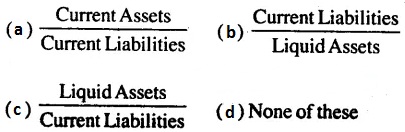
Liquidity Ratio:
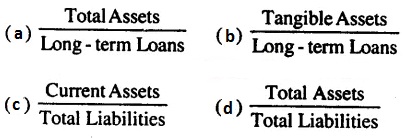
MCQ Questions for Class 12 Accountancy Chapter 10 Accounting Ratios with Answers 4

Answer

Answer: (c)


Question 4.
The ratios are primarily measures of earning capacity of the business.
(a) Liquidity
(b) Activity
(c) Debt
(d) Profitability

Answer

Answer: (d) Profitability


Question 5.
Total Assets ₹ 8,10,000
Total Liabilities ₹ 2,60,000
Current Liabilities ₹ 40,000
Debt-equity ratio is:
(a) 0.05 : 1
(b) 0.4 : 1
(c) 2.5 : 1
(d) 4 : 1

Answer

Answer: (c) 2.5 : 1


Question 6.
Total Assets ₹ 7,70,000
Total Liabilities ₹ 2,60,000
Current Liabilities ₹ 40,000
Total Assets to Debt Ratio is:
(a) 3.5 : 1
(b) 2.56 : 1
(c) 2.8 : 1
(d) 3 : 1

Answer

Answer: (a) 3.5 : 1


Question 7.
Operating Ratio is:
(a) Profitability Ratio
(b) Activity Ratio
(c) Solvency Ratio
(d) None of these

Answer

Answer: (a) Profitability Ratio


Question 8.
The formula for ascertaining Total Assets to Debt Ratio is:
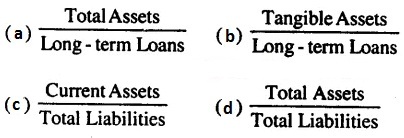
MCQ Questions for Class 12 Accountancy Chapter 10 Accounting Ratios with Answers 1

Answer

Answer: (a)


Question 9.
Which of the following is an operating’ income ?
(a) Sale of Merchandise
(b) Interest Income
(c) Dividend Income
(d) Profit on the sale of old car

Answer

Answer: (a) Sale of Merchandise


Question 10.
Which of the following non-operating expense?
(a) Rent
(b) Selling Expenses
(c) Wages
(d) Loss on Sale of Machinery

Answer

Answer: (d) Loss on Sale of Machinery


Question 11.
Current Ratio includes:
(a) Stock
(b) Debtors
(c) Cash
(d) All of these

Answer

Answer: (c) Cash


Question 12.
Proprietory ratio is calculated by the following formula:
MCQ Questions for Class 12 Accountancy Chapter 10 Accounting Ratios with Answers 2

Answer

Answer: (c)


Question 13.
The following groups of ratios primarily measure risk
(a) Liquidity, activity and profitability
(b) Liquidity, activity and common stock
(c) Liquidity, activity and debt
(d) Activity, debt and profitability

Answer

Answer: (d) Activity, debt and profitability


Question 14.
To know the return on investment, by capital employed we mean:
(a) Net Fixed Assets
(b) Current Asset-Current Liabilities
(c) Gross Block
(d) Fixed Assets + Current Assets-Current Liabilities

Answer

Answer: (d) Fixed Assets + Current Assets-Current Liabilities


Question 15.
The term fixed assets include :
(a) Cash
(b) Machinery
(c) Debtors
(d) Prepaid Expenses

Answer

Answer: (b) Machinery


Question 16.
If sales is 7 4,20,000 sales returns is 7 20,000 and cost of goods sold 7 3,20,000 gross profit ratio will be :
(a) 20%
(b) 25%
(c) 15%
(d) 10%

Answer

Answer: (a) 20%


Question 17.
Ratio based on figures of profit & loss as well a the Balance sheet are:
(a) Profitability Ratios
(b) Operation Ratio
(c) Liquidity Ratio
(d) Composite Ratio

Answer

Answer: (d) Composite Ratio


Question 18.
Equity share capital ₹ 15,00,000
Reserve and Surplus ₹ 7,50,000
Total Assets ₹ 45,00,000
Properletory Ratio ?
(a) 50%
(b) 33.3%
(c) 200%
(d) 60%

Answer

Answer: (a) 50%


Question 19.
Debtors Turnover Ratio :
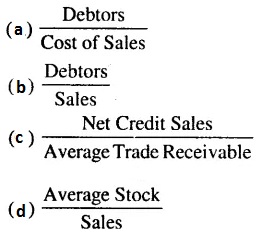
MCQ Questions for Class 12 Accountancy Chapter 10 Accounting Ratios with Answers 3

Answer

Answer: (c)


Question 20.
When opening stock is ₹ 50,000 closing stock ₹ 60,000 and cost of goods sold is ₹ 2,20,000, then stock turn over ratio is:
(a) 2 times
(b) 3 times
(c) 4 times
(d) 5 times

Answer

Answer: (a) 2 times


Question 21.
What does Creditors Turnover Ratio take into account:
(a) Total credit purchases
(b) Total credit sales
(c) Total cash sales
(d) Total cash purchases

Answer

Answer: (a) Total credit purchases


Question 22.
Cost of goods sold :
(a) Sales – Net profit
(b) Sales – Gross profit
(c) Purchases – Opening Stock
(d) None of the above

Answer

Answer: (b) Sales – Gross profit


Question 23.
Proprietory Ratio indicates the relationship between proprietor’s funds and….
(a) Reserve
(b) Share Capital
(c) Total Assets
(d) Debentures

Answer

Answer: (c) Total Assets


Question 24.
The term‘Current Assets’include
(a) Long-term Investment
(b) Short-term Investment
(c) Furniture
(d) Preliminary Expenses

Answer

Answer: (b) Short-term Investment


Question 25.
The ideal liquid ratio is :
(a) 2 : 1
(b) 1 : 1
(c) 5 : 1
(d) 4 : 1

Answer

Answer: (b) 1 : 1


Question 26.
Profitability Ratios are generally expressed in :
(a) Simple Ratio
(b) Percentage
(c) Times
(d) None of these

Answer

Answer: (b) Percentage


Question 27.
Operating Ratio is:
(a) Profitability Ratio
(b) Activity Ratio
(c) Solvency Ratio
(d) None of these

Answer

Answer: (a) Profitability Ratio


Question 28.
Stock turnover ratio comes under :
(a) Liquidity Ratio
(b) Profitability Ratio
(c) Activity Ratio
(d) None of these

Answer

Answer: (c) Activity Ratio


Question 29.
The satisfactory ratio between internal and external equity is. :
(a) 1 : 2
(b) 2 : 1
(c) 3 : 1
(d) 4 : 1

Answer

Answer: (b) 2 : 1


Question 30.
Current Ratio =
(a) Current Assets/Current Liabilities
(b) Liquid Assets/Current Liabilities
(c) Liquid Assets/Current Assets
(d) Fixed Assets/Current Assets

Answer

Answer: (a) Current Assets/Current Liabilities


Question 31.
Liquid Assets include :
(a) Bills Receivable
(b) Debtors
(c) Cash Balance
(d) All of these

Answer

Answer: (d) All of these


Question 32.
The ideal current ratio is :
(a) 2 : 1
(b) 1 : 2
(c) 3 : 2
(d) 3 : 4

Answer

Answer: (a) 2 : 1


Question 33.
Which of the following assets is not taken into consideration in calculating acid-test ratio ?
(a) Cash
(b) Bills Receivable
(c) Stock
(d) None of these

Answer

Answer: (c) Stock


Question 34.
The two basic measures of liquidity are :
(a) Inventory Turnover and Current Ratio
(b) Current Ratio and Liquid Ratio
(c) Current Ratio and Average Collection Period
(d) Current Ratio and Debtors Turnover Ratio

Answer

Answer: (b) Current Ratio and Liquid Ratio


Question 35.
Liquid Ratio is also known as:
(a) Current Ratio
(b) Quick Ratio
(c) Capital Ratio
(d) None of these

Answer

Answer: (b) Quick Ratio


Question 36.
To test the liquidity of a concern which of the following ratios is useful ?
(a) Capital Turnover Ratio
(b) Acid Test Ratio
(c) Stock Turnover Ratio
(d) Net Profit Ratio

Answer

Answer: (b) Acid Test Ratio


Question 37.
Profitability Ratio is generally shown in :
(a) Simple Ratio
(b) Percentage
(c) Times
(d) None of these

Answer

Answer: (b) Percentage


Question 38.
When Cash is 7 10,000 Stock is 7 25,000, B/R is 7 5,000 Creditors is 7 22,000 and Bank Overdraft is 7 8,000 then current ratio is :
(a) 2 : 1
(b) 4 : 3
(c) 3 : 4
(d) 1 : 2

Answer

Answer: (b) 4 : 3


Question 39.
The term ‘Current Liabilities’ does not include: .
(a) Sundry Creditors
(b) Debentures
(c) Bills Payable
(d) Outstanding Expenses

Answer

Answer: (b) Debentures


Recent Posts

In Article

Total Pageviews