CBSE Class 12 Physics - MCQ and Online Tests - Unit 5 - Magnetism and Matter

CBSE Class 12 Physics – MCQ and Online Tests – Unit 5 – Magnetism and Matter

Every year CBSE conducts board exams for 12th standard. These exams are very competitive to all the students. So our website provides online tests for all the 12th subjects. These tests are also very effective and useful for those who preparing for competitive exams like NEET, JEE, CA etc. It can boost their preparation level and confidence level by attempting these chapter wise online tests.

These online tests are based on latest CBSE Class 12 syllabus. While attempting these our students can identify the weak lessons and continuously practice those lessons for attaining high marks. It also helps to revise the NCERT textbooks thoroughly.


CBSE Class 12 Physics – MCQ and Online Tests – Unit 5 – Magnetism and Matter

Question 1.
A magnetic bar of M magnetic moment is placed m the field of magnetic strength B, the torque acting on it is :
(a) \(\vec{M} \).\(\vec{B} \)
(b) –\(\vec{M} \).\(\vec{B} \)
(c) \(\vec{M} \) × \(\vec{B} \).
(d) \(\vec{B} \) × \(\vec{M} \)

Answer

Answer: (c) \(\vec{M} \) × \(\vec{B} \).


Question 2.
What is the magnetic field in the empty space enclosed by the toroidal solenoid of radius ‘R’? ,
(a) Infinity
(b) \(\frac{µ_0}{4π}\).\(\frac{2πl}{R}\)
(c) \(\frac{µ_0}{4π}\).(\(\frac{πl}{R}\))
(d) zero

Answer

Answer: (d) zero


Question 3.
On quadrupling the moment of inertia of a magnet, its frequency of oscillation will become:
(a) half
(b) double
(c) four times
(d) one-fourth

Answer

Answer: (a) half


Question 4.
The dimensional representation of magnetic flux density is :
(a) [MLT-2]
(b) [MLT-2A-1]
(c) [MLT-2A-2]
(d) [MT-2A-1]

Answer

Answer: (d) [MT-2A-1]


Question 5.
S.I. unit of flux is :
(a) Ohm
(b) Weber
(c) Tesla
(d) None

Answer

Answer: (b) Weber


Question 6.
What is the angle of dip at a place where the horizontal component of earth’s magnetic field is equal to the vertical component?
(a) 0°
(b) 30°
(c) 45°
(d) 90°

Answer

Answer: (c) 45°


Question 7.
In a moving coil galvanometer, we use a radial magnetic field so that the galvanometer scale is :
(a) exponential
(b) linear
(c) algebraic
(d) logarithmic

Answer

Answer: (b) linear


Question 8.
Tangent law is applicable only when:
(a) two uniform and mutually perpendicular magnetic fields exist
(b) two magnetic fields exist
(c) horizontal component of earth’s magnetic field is present
(d) uniform magnetic field are used

Answer

Answer: (a) two uniform and mutually perpendicular magnetic fields exist


Question 9.
A current carrying power line carries current from west to east. What will be direction of magnetic field 1 meter above it?
(a) N to S
(b) S to N
(c) E to W
(d) W to E

Answer

Answer: (a) N to S


Question 10.
A magnetic dipole moment is a vector quantity directed from:
(a) S to N
(b) N to S
(c) E to W
(d) W to E

Answer

Answer: (a) S to N


Question 11.
The neutral point in the magnetic field of a horizontally placed bar magnet is a point where the magnetic field due to that bar magnet is:
(a) zero
(b) more than that of earth
(c) less than that of earth
(d) equal to that of earth

Answer

Answer: (d) equal to that of earth


Question 12.
The force acting per unit length of a semi circular wire of radius R carrying a current I is:
(a) \(\frac{µ_0l^2}{4R}\)
(b) \(\frac{µ_0l^2}{2R}\)
(c) \(\frac{µ_0l^2}{R}\)
(d) \(\frac{2µ_0l^2}{R}\)

Answer

Answer: (a) \(\frac{µ_0l^2}{4R}\)


Question 13.
The dimensional representation of \(\sqrt{l/MB}\) is similar to that of:
(a) frequency
(b) time
(c) distance
(d) speed

Answer

Answer: (b) time


Question 14.
The radius of curvature of the path of charged particle in a uniform magnetic file is directly proportional to the
(a) charge on fie particle
(b) Momentum of particle
(c) energy of particle
(d) Strength of field

Answer

Answer: (b) Momentum of particle


Question 15.
Which of the following has a low value in ferrites?
(a) Conductivity
(b) Permeability
(c) Magnetic susceptibility
(d) All the above

Answer

Answer: (a) Conductivity


Question 16.
Which of the following has higher magnetic susceptibility?
(a) diamagnetic
(b) paramagnetic
(c) ferromagnetic
(d) None of these

Answer

Answer: (c) ferromagnetic


Question 17.
The force between two parallel wire 2 × 10⁻⁷ Nm-1, placed 1 m apart to each other in vacuum. The electric current flowing through the wires is:
(a) 1 A
(b) zero
(c) 5 × 10⁶ A
(d) 2 × 10⁻⁷ A

Answer

Answer: (a) 1 A


Question 18.
In a bar magnet, magnetic lines of force z :
(a) are produced only at north pole like rays of light from a bulb
(b) starts from north pole and ends at the south pole
(c) emerge in circular paths from the middle of the bar
(d) run continuously through the bar and outside

Answer

Answer: (b) starts from north pole and ends at the south pole


Question 19.
The Mariner’s compass is provided with Gimbals arrangement so as to :
(a) keep the needle always horizontal
(b) give a direct reading of declination
(c) give the direct value of dip
(d) all of the above

Answer

Answer: (c) give the direct value of dip


Question 20.
Ferrites may be:
(a) ant. ferromagnetic
(b) ferromagnetic
(c) ferrimagnetic
(d) None of the above

Answer

Answer: (b) ferromagnetic


Question 21.
A wire of length I has a magnetic moment M. It is then bent into a semi-circular arc. The neyv magnetic moment is :
(a) M
(b) M.l.
(c) \(\frac{2M}{π}\)
(d) \(\frac{M}{π}\)

Answer

Answer: (c) \(\frac{2M}{π}\)


Question 22.
The magnetic field strength due to a short bar magnet directed along its axial line at a distance r is B. What is its value at the same distance along the equatorial line?
(a) B
(b) 2B
(c) \(\frac{B}{2}\)
(d) \(\frac{B}{4}\)

Answer

Answer: (c) \(\frac{B}{2}\)


Question 23.
The magnetic lines of force inside a bar magnet:
(a) do not exist
(b) depends on area of cross-section of bar magnet
(c) are from N-pole to S-pole of the magnet
(d) are from S-pole to N-pole of the magnet.

Answer

Answer: (d) are from S-pole to N-pole of the magnet.


Question 24.
The relation between geometric length (L) and magnetic length (Lm) is:
(a) Lm = \(\frac{5}{6}\) Lg
(b) Lm = \(\frac{6}{5}\) Lg
(c) (a) Lm = Lg
(d) Lm = 2RY;UL Lg

Answer

Answer: (a) Lm = \(\frac{5}{6}\) Lg


Question 25.
The magnetic field of earth is due to:
(a) induction effect of the sun
(b) the presence of a large magnet at the centre of the earth
(c) interaction of cosmic rays with the current of earth
(d) motion and distribution of some material in an outside the earth

Answer

Answer: (d) motion and distribution of some material in an outside the earth


CBSE Class 12 Physics - MCQ and Online Tests - Unit 4 - Moving Charges and Magnetism

CBSE Class 12 Physics – MCQ and Online Tests – Unit 4 – Moving Charges and Magnetism

Every year CBSE conducts board exams for 12th standard. These exams are very competitive to all the students. So our website provides online tests for all the 12th subjects. These tests are also very effective and useful for those who preparing for competitive exams like NEET, JEE, CA etc. It can boost their preparation level and confidence level by attempting these chapter wise online tests.

These online tests are based on latest CBSE Class 12 syllabus. While attempting these our students can identify the weak lessons and continuously practice those lessons for attaining high marks. It also helps to revise the NCERT textbooks thoroughly.


CBSE Class 12 Physics – MCQ and Online Tests – Unit 4 – Moving Charges and Magnetism

Question 1.
A charged particle of mass m and charge q travels on a circular path of radius r i.e., perpendicular to the magnetic field B. The time taken by particle to complete on revolution is :
(a) \(\frac{2πqB}{m}\)
(b) \(\frac{2πm}{qB}\)
(c) \(\frac{2πmq}{B}\)
(d) \(\frac{2πq^2B}{m}\)

Answer

Answer: (b) \(\frac{2πm}{qB}\)


Question 2.
When we double the radius of a coil keeping the current through it unchanged, what happens to the magnetic field directed along its axis at far off points?
(a) halved
(b) doubled
(c) quadrupled
(d) remains unchanged

Answer

Answer: (d) remains unchanged


Question 3.
The sensitivity of a tangent galvanometer can be increased by increasing:
(a) the radius of the coil
(b) the external magnetic field
(c) the number of turns of the coil
(d) all the above

Answer

Answer: (b) the external magnetic field


Question 4.
A current carring coil is placed in a uniform magnetic field. If the coil turns through an angle θ, then the torque is directly proportional to:
(a) sin θ
(b) cos θ
(c) cot θ
(d) tan θ

Answer

Answer: (b) cos θ


Question 5.
Which of the following is not a unit of magnetic induction?
(a) gauss
(b) tesla
(c) oersted
(d) weber/metre²

Answer

Answer: (c) oersted


Question 6.
The strength of the magnetic field around an infinite current carrying conductor is :
(a) same everywhere
(b) inversely proportional to the distance
(c) directly proportional to the distance
(d) None of these

Answer

Answer: (b) inversely proportional to the distance


Question 7.
A current carrying power line carries current from west to east. Then the direction of the magnetic field 2 m above it is :
(a) west to east
(b) south to north
(c) north to south
(d) None of these

Answer

Answer: (c) north to south


Question 8.
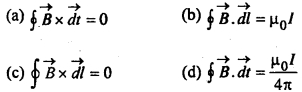
According to Ampere’s Circuital law
MCQ Questions for Class 12 Physics Chapter 4 Moving Charges and Magnetism with Answers

Answer

Answer: (b)


Question 9.
The force between two parallel current carrying conductors is F. If the current in each conductor is doubled, then the force between them becomes :
(a) 4F
(b) 2F
(c) F
(d) \(\frac{F}{4}\)

Answer

Answer: (a) 4F


Question 10.
What happens to the magnetic field at the centre of a circular current carrying coil if we double the radius of the coil keeping the current unchanged?
(a) halved
(b) doubled
(c) quadrupled
(d) remains unchanged

Answer

Answer: (a) halved


Question 11.
How much force will be experienced by a moving charge in a magnetic field? The symbols have their usual meanings.
(a) \(\vec{F}\) = q(\(\vec{v}\).\(\vec{B}\))
(b) \(\vec{F}\) = \(\frac{q}{(\vec{v}.\vec{B})}\)
(c) \(\vec{F}\) = \(\frac{q}{2}\)\((\vec{v}×\vec{B}\))
(d) \(\vec{F}\) = q(\(\vec{v}\)×\(\vec{B}\))

Answer

Answer: (d) \(\vec{F}\) = q(\(\vec{v}\)×\(\vec{B}\))


Question 12.
The magnetic field produced by an / meter long straight (x cry thin) current (I) carry ing conductor at any point on itself is :
(a) zero
(b) infinite
(c) \(\frac{µ_0l}{4πl}\)
(d) \(\frac{µ_0l}{2πl}\)

Answer

Answer: (a) zero


Question 13.
The current sensitibility of a moving coil galanometer increases with decrease in:
(a) magnetic field
(b) area of a coil
(c) number of turns
(d) None of these

Answer

Answer: (d) None of these


Question 14.
A charge + q is sent through a magnetic field. The force acting on it is maximum w hen the angle between the direction of motion of the charged particle and the magnetic field :
(a) 0°
(b) 45°
(c) 90°
(d) 180°

Answer

Answer: (c) 90°


Question 15.
A charge q moves in a region, where electric field E and magnetic field B both exist, then force on it is :
(a) \(\vec{F}\) = q(\(\vec{v}\)×\(\vec{B}\))
(b) \(\vec{F}\) = q{\(\vec{E}\)×(\(\vec{v}\) × \(\vec{B}\))}
(c) \(\vec{F}\) = q(\(\vec{E}\) + (\(\vec{B}\) × \(\vec{v}\))
(d) \(\vec{F}\) = q(\(\vec{B}\) + (\(\vec{E}\) ×\(\vec{v}\))

Answer

Answer: (b) \(\vec{F}\) = q{\(\vec{E}\)×(\(\vec{v}\) × \(\vec{B}\))}


Question 16.
An electron having mass ‘m’ and Kinetic energy E enters in uniform magnetic field B perpendicular, then its frequency will be:
(a) \(\frac{eE}{qmB}\)
(b) \(\frac{2πm}{eB}\)
(c) \(\frac{eB}{2πm}\)
(d) \(\frac{2m}{eBE}\)

Answer

Answer: (c) \(\frac{eB}{2πm}\)


Question 17.
A wire of length 2 metre carries a current 1 ampere, is bent to form a circle. The magnetic moment of the coil is :
(a) 2π
(b) π/2
(c) π/4
(d) 1/π

Answer

Answer: (d) 1/π


Question 18.
The magnetic field of a given length of a ware for single turn coil at its centre is B. Then.its value for two turns of coil will be :
(a) B/4
(b) B/2
(c) 4B
(d) 2B

Answer

Answer: (c) 4B


Question 19.
According to Gauss’s theorem in magnetism, surface integral of magnetic field intensity over a surface (closed or open) is always:
(a) -1
(b) 1
(c) 0
(d) infinity

Answer

Answer: (c) 0


Question 20.
When charged particle enters-a uniform magnetic field, its K.E.:
(a) remains constant
(b) increases
(c) decreases
(d) becomes zero

Answer

Answer: (a) remains constant


Question 21.
To convert galvanometer into voltmeter one should connect :
(a) high resistance in series with galvanometer
(b) low resistance in series with galvanometer
(c) high resistance in parallel with galvanometer
(d) low resistance in parallel with galvanometer

Answer

Answer: (a) high resistance in series with galvanometer


Question 22.
Isoclinic lines are the lines joining places with :
(a) equal dip
(b) equal declination
(cj equal dip and declination
(d) None of these

Answer

Answer: (a) equal dip


Question 23.
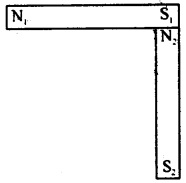
Two identical bar magnets each of dipole moment p and length I are perpendicular to each other as shown in Fig. The dipole moment of the combination is:
MCQ Questions for Class 12 Physics Chapter 4 Moving Charges and Magnetism with Answers
(a) √2 p
(b) \(\frac{p}{√2}\)
(c) P
(d) 2p

Answer

Answer: (a) √2 p


Question 24.
The SI unit of magnetic dipole moment is’
(a) Ampere
(b) Ampere metre²
(c) Tesla
(d) None of these

Answer

Answer: (b) Ampere metre²


Question 25.
Earth’s magnetism was discovered by:
(a) Gauss
(b) Oersted
(c) Ampere
(d) Gilbert

Answer

Answer: (d) Gilbert


Question 26.
The force \(\vec{F}\) experienced by a particle of charge q moving with velocity \(\vec{v}\) in a magnetic field \(\vec{B}\) is given by,
(a) \(\vec{F}\) = q(\(\vec{F}\) × \(\vec{B}\))
(b) \(\vec{F}\) = q(\(\vec{B}\) × (\(\vec{b}\))
(c) \(\vec{F}\) = q(\(\vec{v}\) × (\(\vec{B}\))
(d) \(\vec{F}\) = q(\(\vec{v}\) × \(\vec{B}\))

Answer

Answer: (a) \(\vec{F}\) = q(\(\vec{F}\) × \(\vec{B}\))


Question 27.
Tesla is a unit of:
(a) electric flux
(b) magnetic flux
(c) magnetic field
(d) electric field

Answer

Answer: (c) magnetic field


Question 28.
The permeability of a paramagnetic substance is:
(a) very large
(b) small but more than unity
(c) less than unity
(d) negative

Answer

Answer: (b) small but more than unity


Question 29.
What is the angle of dip at the magnetic poles ?
(a) 30°
(b) 0°
(c) 45°
(d) None of these

Answer

Answer: (d) None of these


Question 30.
10 eV electron is circulating in a plane at right angle to a uniform field of magnetic induction 10-1 Wb/m² (1G). The orbital radius of electron is:
(a) 12 cm
(b) 16 cm
(c) 11 cm
(d) 18 cm

Answer

Answer: (c) 11 cm


Question 31.
Which of the following shows that the earth behaves as a magnet?
(a) Repulsion between like poles .
(b) Attraction between unlike poles
(c) Null points in the magnetic field of a bar magnet
(d) No existence of isolated magnetic poles

Answer

Answer: (c) Null points in the magnetic field of a bar magnet


Question 32.
A cyclotron can be used to produce high energy:
(a) neutrons
(b) deutrons
(c) β particles
(d) α partifcles

Answer

Answer: (d) α partifcles


Question 33.
The radius of the trajectory of a charged particle in a uniform magnetic field is proportional to the:
(a) charge on the particle
(b) energy of the particle
(c) momentum of the particle
(d) all the above

Answer

Answer: (c) momentum of the particle


Question 34.
The most suitable metal for making permanent magnets is :
(a) iron
(b) steel
(c) copper
(d) aluminium

Answer

Answer: (b) steel


Question 35.
Circular loop of radius 0.0157 m carries a current 2 A. The magnetic field at the centre of the loop is :
(a) 1.57 × 10⁻³Wb/m²
(b) 8.0 × 10⁻⁵ Wb/m²
(c) 2.0 × 10⁻³ Wb/m²
(d) 3.l4 × 10-1 Wb/m²

Answer

Answer: (b) 8.0 × 10⁻⁵ Wb/m²


CBSE Class 12 Physics - MCQ and Online Tests - Unit 3 - Current Electricity

CBSE Class 12 Physics – MCQ and Online Tests – Unit 3 – Current Electricity

Every year CBSE conducts board exams for 12th standard. These exams are very competitive to all the students. So our website provides online tests for all the 12th subjects. These tests are also very effective and useful for those who preparing for competitive exams like NEET, JEE, CA etc. It can boost their preparation level and confidence level by attempting these chapter wise online tests.

These online tests are based on latest CBSE Class 12 syllabus. While attempting these our students can identify the weak lessons and continuously practice those lessons for attaining high marks. It also helps to revise the NCERT textbooks thoroughly.


CBSE Class 12 Physics – MCQ and Online Tests – Unit 3 – Current Electricity

Question 1.
Two wires of copper are of the same length but’have different diameters. When they are connected in series across a battery, the heat generated is H1 When connected in parallel across the same battery, the heat generated during the same time is H2 Then :
(a) H1 = H2
(b) H1 < H2
(c) H1 > H2
(d) H1 > H2

Answer

Answer: (b) H1 < H2


Question 2.
The example of a non-ohmic resistance is:
(a) copper wire
(b) fi lament lamp
(c) carbon resistor
(d) diode

Answer

Answer: (d) diode


Question 3.
The specific resistance of a rod of copper as compared to that of thin wire of copper is :
(a) less
(b) more
(c) same
(d) depends upon the length and area of cross-section of the wire

Answer

Answer: (c) same


Question 4.
A wire of resistance 3 Ω is cut into three pieces, which are then joined to form a triangle. The equivalent resistance between any corners of the triangle is :
(a) \(\frac{2}{3}\) Ω
(b) \(\frac{3}{2}\) Ω
(c) \(\frac{1}{2}\) Ω
(d) \(\frac{1}{3}\) Ω

Answer

Answer: (a) \(\frac{2}{3}\) Ω


Question 5.
The length of a conductor is halved. Its resistance will be :
(a) halved
(b) doubled
(c) unchanged
(d) quadrupled

Answer

Answer: (a) halved


Question 6.
If a certain piece of copper is to be shaped into a conductor of minimum resistance, its length (L) and cross-sectional area (a) shall respectively be :
(a) L, 2A
(b) \(\frac{L}{2}\), 2A
(c) 2L, 2A
(d) 2l, \(\frac{A}{2}\)

Answer

Answer: (b) \(\frac{L}{2}\), 2A


Question 7.
Given three equal resistors, how many different combinations (taken all of them together) can be made?
(a) 3
(b) 4
(c) 5
(d) 6

Answer

Answer: (b) 4


Question 8.
Siemen is the unit of:
(a) resistance
(b) conductance
(c) specific conductance
(d) None of these

Answer

Answer: (b) conductance


Question 9.
The speed at which tjie current travels in a conductor is nearly:
(a) 3 × 10⁴ ms-1
(b) 3 × 10⁶ ms-1
(c) 3 × 10⁸ ms-1
(d) 3 × 10¹⁰ ms-1

Answer

Answer: (a) 3 × 10⁴ ms-1


Question 10.
In the above question, the conductance:
(a) halved
(b) doubled
(c) unchanged
(d) quadrupled

Answer

Answer: (b) doubled


Question 11.
Specific resistance of ali metals is mostly affected by:
(a) temperature
(b) pressure
(c) magnetic field
(d) volume

Answer

Answer: (a) temperature


Question 12.
How much electric energy is consumed by a 100 W lamp used for 6 hours everyday for 30 days?
(a) 18 kJ
(b) 18 kWh
(c) 1.8 J
(d) None of these

Answer

Answer: (b) 18 kWh


Question 13.
How many different resistances are possible with two equal resistors?
(a) 2
(b) 3
(c) 4
(d) 5

Answer

Answer: (b) 3


Question 14.
The number of electrons that constitute 1 A of current is:
(a) 6.25 × 10¹⁶
(b) 6.25 × 10¹⁷
(c) 6.25 × 10¹⁸
(d) 6.25 × 10¹⁹

Answer

Answer: (c) 6.25 × 10¹⁸


Question 15.
Suppose H1 is the heat generated per second in the filament of a 100 W, 250 V lamp and H2 is the heat generated in the filament of a 200 W, 250 V lamp. Then H1/H2 is equal to:
(a) 1
(b) 2
(c) \(\frac{1}{2}\)
(d) \(\frac{1}{4}\)

Answer

Answer: (c) \(\frac{1}{2}\)


Question 16.
Kirchhoffs first and second laws for electrical circuits are consequences of:
(a) conservation of energy
(b) conservation of electrical charge and energy respectively
(c) conservation of electric charge
(d) neither conservation of energy nor electric charge

Answer

Answer: (b) conservation of electrical charge and energy respectively


Question 17.
A potential difference of 10 V is applied across a conductance of 2 S. The current in the conductor will be :
(a) 20 A
(b) 5 A
(c) 0.2 A
(d) None of these

Answer

Answer: (a) 20 A


Question 18.
The length and radius of an electric resistance of a certain wire are doubled simultaneously, then the:
(a) resistance will be doubled and specific resistance will be halved
(b) resistance will be halved and specific resistance will remain uncharged
(c) resistance will be halved and the specific resistance will be doubled
(d) resistance and specific resistance will both remain uncharged

Answer

Answer: (b) resistance will be halved and specific resistance will remain uncharged


Question 19.
A galvanometer acting as a volt meter will have with its coil.
(a) a high resistance in parallel
(b) a high resistance in series
(c) a low resistance in parallel
(d) a low resistance in series

Answer

Answer: (b) a high resistance in series


Question 20.
When three identical bulbs of 60 W, 200 V rating are connected in series to a 200 V supply, the power drawn by them will be:
(a) 20 W
(b) 60 W
(c) 180 W
(d) 10 W

Answer

Answer: (a) 20 W


Question 21.
n resistances, each of R Ω, are connected in parallel gives an equivalent resistance of R Ω. If these resistances were , connected in series, the combination would have a resistance in Ω is equal to
(a) n²R
(b) R/n²
(c) R/n
(d) nR

Answer

Answer: (a) n²R


Question 22.
In questions 135, w hen the wires are connected in series, the heat produced in the thinner wire is H1 and that in the thicker wire is H2. Then :
(a) H1 = H2
(b)H1 < H2
(c) H1 > H2
(d) H1 > H2

Answer

Answer: (c) H1 > H2


Question 23.
The resistance of a human body is about:
(a) 12 Ω
(b) 120 Ω
(c) 12 KΩ
(d) 120 MΩ

Answer

Answer: (c) 12 KΩ


Question 24.
Why is the Wheatstone bridge more accurate than other methods of measuring resistances: ‘
(a) It is a null method
(b) It is based on Kirchhoffs laws
(c) It has four resistances
(d) It does not involve ohm’s law

Answer

Answer: (a) It is a null method


Question 25.
A 5 A fuse wire can with stand a maximum power of 1 W in circuit. The resistance of the fuse wire is:
(a) 0.2 Ω
(b) 5 Ω
(c) 0.4 Ω
(d) 0.04 Ω

Answer

Answer: (d) 0.04 Ω


CBSE Class 12 Physics - MCQ and Online Tests - Unit 2 - Electrostatic Potential and Capacitance

CBSE Class 12 Physics – MCQ and Online Tests – Unit 2 – Electrostatic Potential and Capacitance

Every year CBSE conducts board exams for 12th standard. These exams are very competitive to all the students. So our website provides online tests for all the 12th subjects. These tests are also very effective and useful for those who preparing for competitive exams like NEET, JEE, CA etc. It can boost their preparation level and confidence level by attempting these chapter wise online tests.

These online tests are based on latest CBSE Class 12 syllabus. While attempting these our students can identify the weak lessons and continuously practice those lessons for attaining high marks. It also helps to revise the NCERT textbooks thoroughly.


CBSE Class 12 Physics – MCQ and Online Tests – Unit 2 – Electrostatic Potential and Capacitance

Question 1.
In which of the following forms is the energy stored in a capacitor?
(a) Charge
(b) Potential
(c) Capacitance
(d) Electric field

Answer

Answer: (d) Electric field


Question 2.
The capacitance of a capacitor will decrease if we introduce a slab of:
(a) copper
(b) aluminium
(c) zinc
(d) None of these

Answer

Answer: (d) None of these


Question 3.
Twenty seven drops of mercury are charged simultaneously to the same potential of 10 volts. What will be potential if all the charged drops are made to combine to form one large drop ?
(a) 180 V
(b) 90 V
(c) 120 V
(d) 45 V

Answer

Answer: (b) 90 V


Question 4.
Two capacitors of capacitance 6 µF and 4 µF are put in series across a 120 V battery. What is the potential difference across the 4 µF capacitor ?
(a) 72 V
(b) 60 V
(c) 48 V
(d) zero

Answer

Answer: (a) 72 V


Question 5.
The P.E. of an electric dipole is maximum when it makes an angle θ with electric field. The value of θ is :
(a) \(\frac{π}{2}\)
(b) π
(c) zero
(d) \(\frac{3π}{2}\)

Answer

Answer: (b) π


Question 6.
An electron initially at rest is accelerated through a potential difference of one volt. The energy gained by electron is:
(a) 1 J
(b) 1.6 × 10⁻¹⁹ J
(c) 10-19 J
(d) None of these

Answer

Answer: (b) 1.6 × 10⁻¹⁹ J


Question 7.
The dimensions of fall of potential per unit distance are given by:
(a) [MLT-3 A-1]
(b) [ML2T-2A-1]
(c) [ML2T-2A-3]
(d) [MLT-2A-2]

Answer

Answer: (c) [ML2T-2A-3]


Question 8.
If a +ve charge is moved from low to high potential region,
the electric potential energy:
(a) decreases
(b) increases
(c) remain the same
(d) may increase or decrease

Answer

Answer: (b) increases


Question 9.
Two conducting spheres of radii r1 and r2 are equally charged. The ratio of their potential is
(a) (r1/r2
(b) (r1r2
(c)(r1/r2)
(d) (r2/r1)

Answer

Answer: (b) (r1r2


Question 10.
A bird sitting on a high power line:
(a) gets killed instantly
(b) gets a mild shock
(c) gets a fatal shock
(d) is not affected practically

Answer

Answer: (d) is not affected practically


Question 11.
Choose the SI unit of electric potential energy :
(a) Joule
(b) Coulomb
(c) Netwon per coulomb
(d) Erg

Answer

Answer: (a) Joule


Question 12.
The capacitance of earth, viewed as a spherical conductor of radius 6408 km is:
(a) 1420 µF
(b) 712 µF
(c) 680 µF
(d) 540 µF

Answer

Answer: (b) 712 µF


Question 13.
Which of the following is blocked by a capacitor ?
(a) A.C.
(b) D.C.
(c) Both A.C. and D.C.
(d) Neither A.C. nor D. C

Answer

Answer: (b) D.C.


Question 14.
The amount of work required to increase the distance between -6µC and 4µC from 6 cm to 18 cm will be :
(a) 1.8 J
(b) 2.4 J
(c) 1.8 µJ
(d) 2.4 µJ

Answer

Answer: (b) 2.4 J


Question 15.
A capacitor is connected to a cell of emf E having some internal resistance r, the potential across the:
(a) cell is < E
(b) cell is E
(b) cell is > E
(d) capacitor is E

Answer

Answer: (b) cell is E


Question 16.
Two capacitors of 3 µF and 6 µF are connected in series with a battery of P.d. 12 V. The P.d. across 3µF and 6µF
capacitors respectively will be :
(a) 8 V, 4 V
(b) 6 V, 6 V
(c) 4 V, 8 V
(d) 9 V, 3 V

Answer

Answer: (a) 8 V, 4 V


Question 17.
Two copper spheres of the same radius, one solid and the other hollow, are charged to the same potential. Which will have more charge?
(a) Solid sphere
(b) Hollow sphere
(c) Both will have an equal charge
(d) None of these

Answer

Answer: (c) Both will have an equal charge


Question 18.
An electric charge of 425 f µC is removed from a fully charged capacitor of capacitance 8.5µF. Its potential will be lowered by:
(a) 75 V
(b) 100 V
(c) 85 V
(d) 50 V

Answer

Answer: (b) 100 V


Question 19.
The electric potential of earth is taken as:
(a) zero
(b) infinity
(c) unity
(d) None of these

Answer

Answer: (a) zero


Question 20.
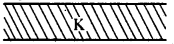
A dielectric is placed in between the two parallel plates of a capacitor as shown in the figure. The dielectric constant of the dielectric being K. If the initial capacity is C, then the new capacity will be:
MCQ Questions for Class 12 Physics Chapter 2 Electrostatic Potential and Capacitance with Answers
(a) (K + l).C
(b) K.C
(c) \(\frac{(K+1)}{2}\) C
(d) (k – l) C

Answer

Answer: (c) \(\frac{(K+1)}{2}\) C


Question 21.
Minimum number of capacitor of 2µF each required to obtain a capacitance of 5µF will be:
(a) 4
(b) 3
(c) 5
(d) 6

Answer

Answer: (a) 4


Question 22.
A capacitor is connected across a battery and the plate separation of capacitor is increased without removing the battery, then:
(a) capacitance will increase
(b) charge stored will increase
(c) energy stored will decrease
(d) potential difference will increase

Answer

Answer: (c) energy stored will decrease


Question 23.
When a dielectric slab is introduced between the plates of a parallel plate capacitor which remains connected to a battery then charge on the plates relative to earlier charge is :
(a) more
(b) less
(c) less or may be more
(d) same

Answer

Answer: (a) more


Ans. (a)

Question 24.
The surface density of charge is measure:
(a) Cm-1
(b) Cm-2
(c) Cm-3
(d) JC-1

Answer

Answer: (b) Cm-2


Question 25.
A polythene piece rubbed with wool is found to have a negative charge of 6.4 × 10⁻⁹c. How many electrons have been transferred during the process?
(a) 4 × 10¹²
(b) 4 × 10¹¹
(c) 4 × 10¹⁰
(d) None of these

Answer

Answer: (c) 4 × 10¹⁰


Question 26.
In the above question:
(a) no electrons are transferred
(b) electrons are transferred from wool to x polythene
(c) electrons are transferred from polythene to wool
(d) nothing can be decided

Answer

Answer: (b) electrons are transferred from wool to x polythene


Question 27.
In previous question, mass transferred to polythene is:
(a) 3.64 × 10²⁰ kg
(b) 4 × 10-28 kg
(c) 4 × 10¹⁰ kg
(d) None of these

Answer

Answer: (a) 3.64 × 10²⁰ kg


Question 28.
What is the number of electrons in 100 g water?
(a) 3.35 × 1024
(b) 3.35 × 1025
(c) 6.02 × 10²³
(d) None of these

Answer

Answer: (a) 3.35 × 1024


Question 29.
Choose the vector physical quantity:
(a) Electric flux
(b) Electric potential
(c) Electric potential energy
(d) Electric intensity

Answer

Answer: (d) Electric intensity


Question 30.
A uniform electric field of 10 NC-1 exists in the vertically downward direction. What is the increase in the electric potential asonegoes up through a height of 300 cm ?
(a) 15 V
(b) 30 V
(c) 45V
(d) None of these

Answer

Answer: (b) 30 V


CBSE Class 12 Physics - MCQ and Online Tests - Unit 1 - Electric Charges and Fields

CBSE Class 12 Physics – MCQ and Online Tests – Unit 1 – Electric Charges and Fields

Every year CBSE conducts board exams for 12th standard. These exams are very competitive to all the students. So our website provides online tests for all the 12th subjects. These tests are also very effective and useful for those who preparing for competitive exams like NEET, JEE, CA etc. It can boost their preparation level and confidence level by attempting these chapter wise online tests.

These online tests are based on latest CBSE Class 12 syllabus. While attempting these our students can identify the weak lessons and continuously practice those lessons for attaining high marks. It also helps to revise the NCERT textbooks thoroughly.


CBSE Class 12 Physics – MCQ and Online Tests – Unit 1 – Electric Charges and Fields

Question 1.
Electric field in a cavity of metal:
(a) depends upon the surroundings
(b) depends upon the size of cavity
(c) is always zero
(d) is not necessarily zero

Answer

Answer: (d) is not necessarily zero


Question 2.
1 coulomb is equal to:
(a) 3 × 10⁹ e.s.u.
(b) \(\frac{1}{3}\) × 109 e.s.u.
(c) 3 × 10¹⁰ e.s.u.
(d) \(\frac{1}{3}\) × 1010 e.s.u.

Answer

Answer: (a) 3 × 10⁹ e.s.u.


Question 3.
A parrot comes and sits on a bare high power line. It will:
(a) experience a mild shock ‘
(b) experience a strong shock.
(c) get killed instantaneously
(d) not be affected practically

Answer

Answer: (d) not be affected practically


Question 4.
Three charges + 3q + q and Q are placed on a st. line with equal separation. In order to maket the net force on q to be zero, the value of Q will be :
(a) +3q
(b) +2q
(c) -3q
(d) -4q

Answer

Answer: (a) +3q


Question 5.
Each of the two point charges are doubled and their distance is halved. Force of interaction becomes p times, w here p is :
(a) 1
(b) 4
(c) \(\frac{1}{16}\)
(d) 16

Answer

Answer: (d) 16


Question 6.
The dimensional representation of cu will be :
(a) [MLT4 A2]
(b) [M-1L-3T4A2]
(c)[ML-2T ]
(d) None of these

Answer

Answer: (b) [M-1L-3T4A2]


Question 7.
When placed in a uniform field, a dipole experiences:
(a) a net force
(b) a torque
(c) both a net force and torque
(d) neither a net force nor a torque

Answer

Answer: (b) a torque


Question 8.
The SI units of electric dipole moment are:
(a) C
(b) Cm-1
(c) Cm
(d) Nm-1

Answer

Answer: (c) Cm


Question 9.
The dielectric constant of a metal is:
(a) 0
(b) 1
(c) ∞
(d) -1

Answer

Answer: (c) ∞


Question 10.
If sphere of bad conductor is given charge then it is distributed on:
(a) surface
(b) inside the surface
(c) only inside the surface
(d) None

Answer

Answer: (d) None


Question 11.
Which one of the following is the unit of electric field?
(a) Coulomb
(b) Newton
(c) Volt
(d) N/C

Answer

Answer: (d) N/C


Question 12.
If two conducting sphere are connected after charging separately then:
(a) Electrostatic energy sphere energy will remain conserved
(b) Electrostatic energy charges remains conserved
(c) Electrostatic energy energy and charge remains conserved
(d) None

Answer

Answer: (b) Electrostatic energy charges remains conserved


Question 13.
The number of electron-taken out from a body to produce 1 coulomb of charge will be :
(a) 6.25 × 10¹⁸
(b) 625 × 1018
(c) 6.023 × 10²³
(d) None

Answer

Answer: (a) 6.25 × 10¹⁸


Question 14.
The work done in rotating an electric dipole in an electric field:
(a) W = ME (1 – cos θ)
(b) W = ME tan θ
(c)W = ME sec θ
(d) None

Answer

Answer: (a) W = ME (1 – cos θ)


Question 15.
In non-uniform electric field, electric dipole experiences:
(a) torque only
(b) torque as well as net force
(c) force only
(d) None of these

Answer

Answer: (b) torque as well as net force


Question 16.
Coulomb’s law in vector form can be written as
\(\vec{F} \) = (\(\frac{1}{4πε_n}\)) (\(\frac{q_1q_2}{r^2}\))\(\vec{r} \)
where ε0 is the permitivity of free space. The SI units of ε0 will be:
(a) N-1m-2C-2
(b) Nm-2C2
(c) N-1m-2C9.
(d) Nm-2C2

Answer

Answer: (c) N-1m-2C9


Question 17.
The belt of a Vande Graaf generator gets charge by :
(a) corona discharge
(b) induction
(c) electrification
(d) None of these

Answer

Answer: (a) corona discharge


Question 18.
An electron is sent in an electric field of magnitude 9.1 × 10⁶NC-1. The acceleration produced in it is :
(a) 1.6 ms-2
(b) 1.6 × 10¹⁸ms-2
(c) 3.2 × 10¹⁸ms-2
(d) 0.8 × 10¹⁸ ms-2

Answer

Answer: (b) 1.6 × 10¹⁸ms-2


Question 19.
Two point charges +8q and -2q are located at ,v = O and ,v = L respectively. The location of a point on the .v-axis at which the net electric field due to these two point charges b is zero :
(a) 4L
(b) 8L
(c) L/4
(d) 2L

Answer

Answer: (d) 2L


Question 20.
A semicircular arc of radius r is charged uniformly and the charge per unit length is λ. The electric field at the centre is:
(a) \(\frac{λ}{2λε_0r^2}\)
(b) \(\frac{λ}{4πε_0r}\)
(c) \(\frac{λ^2}{2πε_0r}\)
(d) \(\frac{λ}{2πε_0r}\)

Answer

Answer: (b) \(\frac{λ}{4πε_0r}\)


Question 21.
The graph drawn between V are r for a non-conducting charged solid sphere of radius R for r < R will be :
(a) straight line
(b) parabola
(c) hyperbola
(d) None of these

Answer

Answer: (d) None of these


Question 22.
If an electric dipole is kept in a uniform electric field then resultant electric force on it is :
(a) always zero
(b) never zero
(c) depend upon capacity of dipole
(d) None

Answer

Answer: (a) always zero


Question 23.
Corona discharge takes place:
(a) at the surface of a conductor
(b) near the sharp points of a conductor
(c) outside the conductor
(d) at the centre of the conductor

Answer

Answer: (b) near the sharp points of a conductor


Question 24.
A soap bubble is given a negative charge, then its radius:
(a) increases
(b) decreases
(c) remains unchanged
(d) may increase or decrease

Answer

Answer: (a) increases


Question 25.
When a dipole of moment \(\vec{p} \) is placed in uniform electric field \(\vec{E} \), then the torque acting on the dipole is:
(a) \(\vec{τ} \) = \(\vec{p} \).\(\vec{E} \)
(b) \(\vec{τ} \) = \(\vec{P} \) + \(\vec{E} \)
(c) \(\vec{τ} \) = \(\vec{p} \) + \(\vec{E} \)
(d ) \(\vec{τ} \) = \(\vec{p} \) – \(\vec{E} \)

Answer

Answer: (c) \(\vec{τ} \) = \(\vec{p} \) + \(\vec{E} \)


CBSE Class 12 Maths - MCQ and Online Tests - Unit 13 - Probability

CBSE Class 12 Maths – MCQ and Online Tests – Unit 13 – Probability

Every year CBSE conducts board exams for 12th standard. These exams are very competitive to all the students. So our website provides online tests for all the 12th subjects. These tests are also very effective and useful for those who preparing for competitive exams like NEET, JEE, CA etc. It can boost their preparation level and confidence level by attempting these chapter wise online tests.

These online tests are based on latest CBSE Class 12 syllabus. While attempting these our students can identify the weak lessons and continuously practice those lessons for attaining high marks. It also helps to revise the NCERT textbooks thoroughly.


CBSE Class 12 Maths – MCQ and Online Tests – Unit 13 – Probability

Question 1.
If P (a) = \(\frac{3}{8}\), P(b) = \(\frac{1}{2}\) and P(A∩B) = \(\frac{1}{4}\) then P(\(\frac{A’}{B’}\)) =
(a) \(\frac{1}{4}\)
(b) \(\frac{1}{3}\)
(c) \(\frac{3}{4}\)
(d) \(\frac{3}{8}\)

Answer

Answer: (b) \(\frac{1}{3}\)


Question 2.
If A and B are two events such that P(a) ≠ 0 and P(\(\frac{B}{A}\)) = 1, then
(a) B ⊂ A
(b) B = φ
(c) A ⊂ B
(d) A ∩ B = φ

Answer

Answer: (c) A ⊂ B


Question 3.
If A and B are any two events such that P(a) + P(b) – P(A∩B) = P(a) then
(a) P(\(\frac{B}{A}\)) = 1
(b) P(\(\frac{B}{A}\)) = 0
(c) P(\(\frac{A}{B}\)) = 1
(d) P(\(\frac{A}{B}\)) = 0

Answer

Answer: (c) P(\(\frac{A}{B}\)) = 1


Question 4.
If A and B are events such that P (A∪B) = \(\frac{3}{4}\). P(A∩B) = \(\frac{1}{4}\), P(a) = \(\frac{2}{3}\) then P(AB) is
(a) \(\frac{3}{8}\)
(b) \(\frac{5}{8}\)
(c) \(\frac{5}{12}\)
(d) \(\frac{1}{4}\)

Answer

Answer: (b) \(\frac{5}{8}\)


Question 5.
If one card is drawn out of 52 playing cards, the probability that it is an dice is
(a) \(\frac{1}{26}\)
(b) \(\frac{1}{13}\)
(c) \(\frac{1}{52}\)
(d) \(\frac{1}{4}\)

Answer

Answer: (b) \(\frac{1}{13}\)


Question 6.
The chance of getting a doublet with 2 dice is
(a) \(\frac{2}{3}\)
(b) \(\frac{1}{6}\)
(c) \(\frac{5}{6}\)
(d) \(\frac{5}{36}\)

Answer

Answer: (b) \(\frac{1}{6}\)


Question 7.
Two number are chosen, one by one without replacement from the set of number A = {1, 2, 3, 4, 5, 6} then the probability that minimum value of two number chosen is less than 4 is
(a) \(\frac{14}{15}\)
(b) \(\frac{1}{15}\)
(c) \(\frac{1}{5}\)
(d) \(\frac{8}{5}\)

Answer

Answer: (b) \(\frac{1}{15}\)


Question 8.
If P(x) = \(\frac{2}{15}\); y = 1, 2, 3, 4, 5, 0 otherwise then P|x = 1 or 2| is
(a) \(\frac{1}{15}\)
(b) \(\frac{2}{15}\)
(c) \(\frac{1}{5}\)
(d) None of these

Answer

Answer: (c) \(\frac{1}{5}\)


Question 9.
The probability of an event is \(\frac{3}{7}\). Then odd against the event is
(a) 4 : 3
(b) 7 : 3
(c) 3 : 7
(d) 3 : 4

Answer

Answer: (a) 4 : 3


Question 10.
Five horse are in a race. Mr. A select two of the horses at random and best on them. The probability that Mr. A select the winning horses is
(a) \(\frac{4}{5}\)
(b) \(\frac{3}{5}\)
(c) \(\frac{1}{5}\)
(d) \(\frac{2}{5}\)

Answer

Answer: (d) \(\frac{2}{5}\)


Question 11.
If A and B are two independent events, then
(a) P(A∩B) = P(a) × P(b)
(b) P(AB) = 1 – P(A’) P(B’)
(c) P(AB) = 1 + P (A’) P(B’) P(A’)
(d) P (AB) = \(\frac{P(A’)}{P(B’)}\)

Answer

Answer: (a) P(A∩B) = P(a) × P(b)


Question 12.
The probability of India w inning a test match against. West Indies is \(\frac{1}{2}\). Assuming independence from match to match the probability that in a match series India second win occurs at the third test is
(a) \(\frac{1}{6}\)
(b) \(\frac{1}{4}\)
(c) \(\frac{1}{2}\)
(d) \(\frac{2}{3}\)

Answer

Answer: (b) \(\frac{1}{4}\)


Question 13.
P(A∩B) = \(\frac{3}{8}\), P(b) = \(\frac{1}{2}\) and P(a) = \(\frac{1}{4}\) then P(\(\frac{B’}{A’}\)) =
(a) \(\frac{3}{5}\)
(b) \(\frac{5}{8}\)
(c) \(\frac{3}{8}\)
(d) \(\frac{5}{6}\)

Answer

Answer: (d) \(\frac{5}{6}\)


Question 14.
Three distinct numbers.are selected from First 100 natural numbers. The probability divisible by 2 and 3 is
(a) \(\frac{9}{25}\)
(b) \(\frac{4}{35}\)
(c) \(\frac{4}{55}\)
(d) \(\frac{4}{1155}\)

Answer

Answer: (d) \(\frac{4}{1155}\)


Question 15.
A pair of dice are rolled. The probability of obtaining an even prime number on each die is
(a) \(\frac{1}{36}\)
(b) \(\frac{1}{12}\)
(c) \(\frac{1}{6}\)
(d) 0

Answer

Answer: (a) \(\frac{1}{36}\)


Question 16.
If P(a) = \(\frac{3}{8}\), P(b) = \(\frac{1}{3}\) and P(A∩B) = — then P (A’ ∩B’)
(a) \(\frac{13}{24}\)
(b) \(\frac{13}{8}\)
(c) \(\frac{13}{9}\)
(d) \(\frac{13}{4}\)

Answer

Answer: (a) \(\frac{13}{24}\)


Question 17.
The probability that A speaks truth is \(\frac{4}{5}\) while this probability for B is \(\frac{3}{4}\). The probability that they contradict each others when asked to speak ana fact is
(a) \(\frac{7}{20}\)
(b) \(\frac{1}{5}\)
(c) \(\frac{3}{20}\)
(d) \(\frac{4}{5}\)

Answer

Answer: (d) \(\frac{4}{5}\)


Question 18.
If P(a) = \(\frac{7}{10}\) P(b) = \(\frac{7}{10}\) and P(A∪B) = \(\frac{7}{10}\) then P (B|A) + P(A|B) equals
(a) \(\frac{1}{4}\)
(b) \(\frac{1}{3}\)
(c) \(\frac{5}{12}\)
(d) \(\frac{7}{12}\)

Answer

Answer: (d) \(\frac{7}{12}\)


Question 19.
Two dice are tossed once. The probability of getting an even number at the first dice ora total of 8 is
(a) \(\frac{1}{36}\)
(b) \(\frac{3}{36}\)
(c) \(\frac{11}{36}\)
(d) \(\frac{5}{9}\)

Answer

Answer: (d) \(\frac{5}{9}\)


Question 20.
A pair of dice are rolled. The probability of obtaining an even prime number on each dice is
(a) \(\frac{1}{36}\)
(b) \(\frac{1}{12}\)
(c) \(\frac{1}{6}\)
(d) 0

Answer

Answer: (a) \(\frac{1}{36}\)


Question 21.
If A, B are two events associated with same random experiment such that P(a) = 0.4, P(b) = 0.8 and P(B/A) = 0.6 then P(A/B) is
(a) 0.3
(b) 0.4
(c) 0.5
(d) 0.6

Answer

Answer: (a) 0.3


Question 22.
If P(a) = \(\frac{3}{8}\), P(b) = \(\frac{5}{8}\), P(A∪B) = \(\frac{3}{4}\) then p(\(\frac{B}{A}\)) is
(a) \(\frac{3}{47}\)
(b) \(\frac{5}{49}\)
(c) \(\frac{2}{3}\)
(d) \(\frac{1}{4}\)

Answer

Answer: (c) \(\frac{2}{3}\)


Question 23.
If A and B are two events such that P(a) ≠ 0 and P(\(\frac{B}{A}\)) = 1 then
(a) P(\(\frac{A}{B}\)) = 1
(b) P(\(\frac{B}{A}\)) = 1
(c) P(\(\frac{A}{B}\)) = 0
(d) P(\(\frac{B}{A}\)) = 0

Answer

Answer: (b) P(\(\frac{B}{A}\)) = 1


Question 24.
An urn contain’s balls of which 3 are red, 4 are blue and 2 are green, 3 balls are drawn at random without replacement from the urn. The probability that the 3 balls haye different colours is
(a) \(\frac{1}{3}\)
(b) \(\frac{2}{7}\)
(c) \(\frac{1}{21}\)
(d) \(\frac{2}{23}\)

Answer

Answer: (b) \(\frac{2}{7}\)


Question 25.
An experiment has 10 equally likely outcomes. Let A and B be two non-empty events of the experiment. A consists 4 outcomes, the number of outcomes that B must have so that A and B are independent is
(a) 2, 4 or 8
(b) 36 or 9
(c) 4 or 8
(d) 5 or 10

Answer

Answer: (d) 5 or 10


Question 26.
The mean and the variance of binomial distribution are 4 and 2, respectively. Then the probability of 2 success
(a) \(\frac{128}{256}\)
(b) \(\frac{219}{256}\)
(c) \(\frac{7}{64}\)
(d) \(\frac{28}{256}\)

Answer

Answer: (c) \(\frac{7}{64}\)


Question 27.
If P(a) = \(\frac{4}{5}\) and P(A∩B) = \(\frac{7}{10}\), then P(B/A) is equal
(a) \(\frac{1}{10}\)
(b) \(\frac{1}{8}\)
(c) \(\frac{7}{8}\)
(d) \(\frac{17}{20}\)

Answer

Answer: (d) \(\frac{17}{20}\)


Question 28.
If P(A∩B) = \(\frac{7}{10}\) and P(b) = \(\frac{17}{20}\), then P(A|B) equals
(a) \(\frac{14}{17}\)
(b) \(\frac{17}{20}\)
(c) \(\frac{7}{8}\)
(d) \(\frac{1}{8}\)

Answer

Answer: (a) \(\frac{14}{17}\)


Question 29.
If A and B are two independent events with P(a) = \(\frac{3}{5}\) and P (b) = \(\frac{4}{9}\), then P (A’∩B’) equals
(a) \(\frac{4}{15}\)
(b) \(\frac{8}{15}\)
(c) \(\frac{1}{3}\)
(d) \(\frac{2}{9}\)

Answer

Answer: (d) \(\frac{2}{9}\)


Question 30.
Let A and B two event such that P(a) = \(\frac{3}{8}\), P(b) = \(\frac{5}{8}\) and P(A∪B) = \(\frac{3}{4}\). Then P(A|B).P(A’|B) is equal to
(a) \(\frac{2}{5}\)
(b) \(\frac{3}{8}\)
(c) \(\frac{3}{20}\)
(d) \(\frac{6}{25}\)
Ans. (d)

Answer

Answer: (d) \(\frac{6}{25}\)


CBSE Class 12 Maths - MCQ and Online Tests - Unit 12 - Linear Programming

CBSE Class 12 Maths – MCQ and Online Tests – Unit 12 – Linear Programming

Every year CBSE conducts board exams for 12th standard. These exams are very competitive to all the students. So our website provides online tests for all the 12th subjects. These tests are also very effective and useful for those who preparing for competitive exams like NEET, JEE, CA etc. It can boost their preparation level and confidence level by attempting these chapter wise online tests.

These online tests are based on latest CBSE Class 12 syllabus. While attempting these our students can identify the weak lessons and continuously practice those lessons for attaining high marks. It also helps to revise the NCERT textbooks thoroughly.


CBSE Class 12 Maths – MCQ and Online Tests – Unit 12 – Linear Programming

Question 1.
The maximum value of Z = 4x + 2y subject to the constraints 2x + 3y ≤ 18, x + y ≥ 10, x, y ≤ 0 is
(a) 36
(b) 40
(c) 30
(d) None of these

Answer

Answer: (d) None of these


Question 2.
In equation 3x – y ≥ 3 and 4x – 4y > 4
(a) Have solution for positive x and y
(b) Have no solution for positive x and y
(c) Have solution for all x
(d) Have solution for all y

Answer

Answer: (a) Have solution for positive x and y


Question 3.
Maximize Z = 3x + 5y, subject to x + 4y ≤ 24, 3x + y ≤ 21, x + y ≤ 9, x ≥ 0, y ≥ 0
(a) 20 at (1, 0)
(b) 30 at (0, 6)
(c) 37 at (4, 5)
(d) 33 at (6, 3)

Answer

Answer: (c) 37 at (4, 5)


Question 4.
The maximum value of Z = 3x + 4y subjected to contraints x + y ≤ 40, x + 2y ≤ 60, x ≥ 0 and y ≥ 0 is
(a) 120
(b) 140
(c) 100
(d) 160

Answer

Answer: (b) 140


Question 5.
Maximize Z = 7x + 11y, subject to 3x + 5y ≤ 26, 5x + 3y ≤ 30, x ≥ 0, y ≥ 0
(a) 59 at (\(\frac{9}{2}\), \(\frac{5}{2}\))
(b) 42 at (6, 0)
(c) 49 at (7, 0)
(d) 57.2 at (0, 5.2)

Answer

Answer: (a) 59 at (\(\frac{9}{2}\), \(\frac{5}{2}\))


Question 6.
Maximize Z = 11 x + 8y subject to x ≤ 4, y ≤ 6, x + y ≤ 6, x ≥ 0, y ≥ 0.
(a) 44 at (4, 2)
(b) 60 at (4, 2)
(c) 62 at (4, 0)
(d) 48 at (4, 2)

Answer

Answer: (b) 60 at (4, 2)


Question 7.
Feasible region in the set of points which satisfy
(a) The objective functions
(b) Some the given constraints
(c) All of the given constraints
(d) None of these

Answer

Answer: (c) All of the given constraints


Question 8.
A set of values of decision variables which satisfies the linear constraints and nn-negativity conditions of a L.P.P. is called its
(a) Unbounded solution
(b) Optimum solution
(c) Feasible solution
(d) None of these

Answer

Answer: (c) Feasible solution


Question 9.
Maximize Z = 4x + 6y, subject to 3x + 2y ≤ 12, x + y ≥ 4, x, y ≥ 0
(a) 16 at (4, 0)
(b) 24 at (0, 4)
(c) 24 at (6, 0)
(d) 36 at (0, 6)

Answer

Answer: (d) 36 at (0, 6)


Question 10.
Maximize Z = 6x + 4y, subject to x ≤ 2, x + y ≤ 3, -2x + y ≤ 1, x ≥ 0, y ≥ 0
(a) 12 at (2, 0)
(b) \(\frac{140}{3}\) at (\(\frac{2}{3}\), \(\frac{1}{3}\))
(c) 16 at (2, 1)
(d) 4 at (0, 1)

Answer

Answer: (c) 16 at (2, 1)


Question 11.
Maximize Z = 10 x1 + 25 x2, subject to 0 ≤ x1 ≤ 3, 0 ≤ x2 ≤ 3, x1 + x2 ≤ 5
(a) 80 at (3, 2)
(b) 75 at (0, 3)
(c) 30 at (3, 0)
(d) 95 at (2, 3)

Answer

Answer: (d) 95 at (2, 3)


Question 12.
Z = 20x1 + 202, subject to x1 ≥ 0, x2 ≥ 0, x1 + 2x2 ≥ 8, 3x1 + 2x2 ≥ 15, 5x1 + 2x2 ≥ 20. The minimum value of Z occurs at
(a) (8, 0)
(b) (\(\frac{5}{2}\), \(\frac{15}{4}\))
(c) (\(\frac{7}{2}\), \(\frac{9}{4}\))
(d) (0, 10)

Answer

Answer: (c) (\(\frac{7}{2}\), \(\frac{9}{4}\))


Question 13.
Refer to Question 18 (Maximum value of Z+ Minimum value of Z) is equal to
(a) 13
(b) 1
(c) -13
(d) -17

Answer

Answer: (d) -17


Question 14.
Z = 6x + 21 y, subject to x + 2y ≥ 3, x + 4y ≥ 4, 3x + y ≥ 3, x ≥ 0, y ≥ 0. The minimum value of Z occurs at
(a) (4, 0)
(b) (28, 8)
(c) (2, \(\frac{7}{2}\))
(d) (0, 3)

Answer

Answer: (c) (2, \(\frac{7}{2}\))


Question 15.
Of all the points of the feasible region for maximum or minimum of objective function the points
(a) Inside the feasible region
(b) At the boundary line of the feasible region
(c) Vertex point of the boundary of the feasible region
(d) None of these

Answer

Answer: (c) Vertex point of the boundary of the feasible region


Question 16.
The corner point of the feasible region determined by the system of linear constraints are (0, 0), (0, 40), (20, 40), (60, 20), (60, 0). The objective function is Z = 4x + 3y.
Compare the quantity in Column A and Column B

Column AColumn B
Maximum of Z325

(a) The quantity in column A is greater
(b) The quantity in column B is greater
(c) The two quantities are equal
(d) The relationship cannot be determined On the basis of the information supplied

Answer

Answer: (b) The quantity in column B is greater


Question 17.
The maximum value of the object function Z = 5x + 10 y subject to the constraints x + 2y ≤ 120, x + y ≥ 60, x – 2y ≥ 0, x ≥ 0, y ≥ 0 is
(a) 300
(b) 600
(c) 400
(d) 800

Answer

Answer: (b) 600


Question 18.
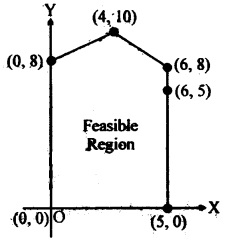
The feasible region for a LPP is shown shaded in the figure. Let Z = 3x – 4y be the objective function. Minimum of Z occurs at
MCQ Questions for Class 12 Maths Chapter 12 Linear Programming with Answers
(a) (0, 0)
(b) (0, 8)
(c) (5, 0)
(d) (4, 10)

Answer

Answer: (b) (0, 8)


Question 19.
Objective function of a linear programming problem is
(a) a constraint
(b) function to be obtimized
(c) A relation between the variables
(d) None of these

Answer

Answer: (b) function to be obtimized


Question 20.
Refer to Question 18 maximum of Z occurs at
(a) (5, 0)
(b) (6, 5)
(c) (6, 8)
(d) (4, 10)

Answer

Answer: (a) (5, 0)


CBSE Class 12 Maths - MCQ and Online Tests - Unit 11 - Three Dimensional Geometry

CBSE Class 12 Maths – MCQ and Online Tests – Unit 11 – Three Dimensional Geometry

Every year CBSE conducts board exams for 12th standard. These exams are very competitive to all the students. So our website provides online tests for all the 12th subjects. These tests are also very effective and useful for those who preparing for competitive exams like NEET, JEE, CA etc. It can boost their preparation level and confidence level by attempting these chapter wise online tests.

These online tests are based on latest CBSE Class 12 syllabus. While attempting these our students can identify the weak lessons and continuously practice those lessons for attaining high marks. It also helps to revise the NCERT textbooks thoroughly.


CBSE Class 12 Maths – MCQ and Online Tests – Unit 11 – Three Dimensional Geometry

Question 1.
The direction cosines of the y-axis are
(a) (6, 0, 0)
(b) (1, 0, 0)
(c) (0, 1, 0)
(d) (0, 0, 1)

Answer

Answer: (c) (0, 1, 0)


Question 2.
The direction ratios of the line joining the points (x, y, z) and (x2, y2, z1) are
(a) x1 + x2, y1 + y2, z1 + z2
(b) \(\sqrt{(x_1 – x_2)^2 + (y_1 – y_2)^2 + (z_1 + z_2)^2}\)
(c) \(\frac{x_1+x_2}{2}\), \(\frac{y_1+y_2}{2}\), \(\frac{z_1+z_2}{2}\)
(d) x2 – x1, y2 – y1, z2 – z1

Answer

Answer: (d) x2 – x1, y2 – y1, z2 – z1


Question 3.
The coordinates of the midpoints of the line segment joining the points (2, 3, 4) and (8, -3, 8) are
(a) (10, 0, 12)
(b) (5, 6, 0)
(c) (6, 5, 0)
(d) (5, 0, 6)

Answer

Answer: (d) (5, 0, 6)


Question 4.
If the planes a1x + b, y + c, z + d1 = 0 and a2x + b, y + c2z + d2 = 0 are perpendicular to each other then
(a) \(\frac{a_1}{a_2}\) = \(\frac{b_1}{b_2}\) = \(\frac{c_1}{c_2}\)
(b) \(\frac{a_1}{a_2}\) + \(\frac{b_1}{b_2}\), \(\frac{c_1}{c_2}\)
(c) a1a2 + b1b2 + c1c2 = 0
(d) a\(_{1}^{2}\)a\(_{2}^{2}\) + b\(_{1}^{2}\)b\(_{2}^{2}\) + c\(_{1}^{2}\)c\(_{2}^{2}\) = 0

Answer

Answer: (c) a1a2 + b1b2 + c1c2 = 0


Question 5.
The distance of the plane 2x – 3y + 6z + 7 = 0 from the point (2, -3, -1) is
(a) 4
(b) 3
(c) 2
(d) \(\frac{1}{5}\)

Answer

Answer: (c) 2


Question 6.
The direction cosines of the normal to the plane 2x – 3y – 6z – 3 = 0 are
(a) \(\frac{2}{7}\), \(\frac{-3}{7}\), \(\frac{-6}{7}\)
(b) \(\frac{2}{7}\), \(\frac{3}{7}\), \(\frac{6}{7}\)
(c) \(\frac{-2}{7}\), \(\frac{-3}{7}\), \(\frac{-6}{7}\)
(d) None of these

Answer

Answer: (a) \(\frac{2}{7}\), \(\frac{-3}{7}\), \(\frac{-6}{7}\)


Question 7.
If 2x + 5y – 6z + 3 = 0 be the equation of the plane, then the equation of any plane parallel to the given plane is
(a) 3x + 5y – 6z + 3 = 0
(b) 2x – 5y – 6z + 3 = 0
(c) 2x + 5y – 6z + k = 0
(d) None of these

Answer

Answer: (c) 2x + 5y – 6z + k = 0


Question 8.
(2, – 3, – 1) 2x – 3y + 6z + 7 = 0
(a) 4
(b) 3
(c) 2
(d) \(\frac{1}{5}\)

Answer

Answer: (c) 2


Question 9.
The length of the ⊥er from the point (0, – 1, 3) to the plane 2x + y – 2z + 1 = 0 is
(a) 0
(b) 2√3
(c) \(\frac{2}{3}\)
(d) 2

Answer

Answer: (d) 2


Question 10.
The shortest distance between the lines \(\vec{r}\) = \(\vec{a}\) + k\(\vec{b}\) and r = \(\vec{a}\) + l\(\vec{c}\) is (\(\vec{b}\) and \(\vec{c}\) are non-collinear)
(a) 0
(b) |\(\vec{b}\).\(\vec{c}\)|
(c) \(\frac{|\vec{b}×\vec{c}|}{|\vec {a}|}\)
(d) \(\frac{|\vec{b}.\vec{c}|}{|\vec {a}|}\)

Answer

Answer: (a) 0


Question 11.
The equation xy = 0 in three dimensional space is represented by
(a) a plane
(b) two plane are right angles
(c) a pair of parallel planes
(d) a pair of st. line

Answer

Answer: (b) two plane are right angles


Question 12.
The direction cosines of any normal to the xy plane are
(a) 1, 0 ,0
(b) 0, 1, 0
(c) 1, 1, 0
(d) 1, 1, 0

Answer

Answer: (d) 1, 1, 0


Question 13.
How many lines through the origin in make equal angles with the coordinate axis?
(a) 1
(b) 4
(c) 8
(d) 2

Answer

Answer: (c) 8


Question 14.
The direction cosines of the line joining (1, -1, 1) and (-1, 1, 1) are
(a) 2, -2, 0
(b) 1, -1, 0
(c) \(\frac{1}{√2}\), – \(\frac{1}{√2}\)
(d) None of these

Answer

Answer: (c) \(\frac{1}{√2}\), – \(\frac{1}{√2}\)


Question 15.
The equation x² – x – 2 = 0 in three dimensional space is represented by
(a) A pair of parallel planes
(b) A pair of straight lines
(c) A pair of perpendicular plane
(d) None of these

Answer

Answer: (a) A pair of parallel planes


Question 16.
The distance of the point (-3, 4, 5) from the origin
(a) 50
(b) 5√2
(c) 6
(d) None of these

Answer

Answer: (b) 5√2


Question 17.
If a line makes angles Q1, Q21 and Q3 respectively with the coordinate axis then the value of cos² Q1 + cos² Q2 + cos² Q3
(a) 2
(b) 1
(c) 4
(d) \(\frac{3}{2}\)

Answer

Answer: (b) 1


Question 18.
The direction ratios of a line are 1,3,5 then its direction cosines are
(a) \(\frac{1}{\sqrt{35}}\), \(\frac{3}{\sqrt{35}}\), \(\frac{5}{\sqrt{35}}\)
(b) \(\frac{1}{9}\), \(\frac{1}{3}\), \(\frac{5}{9}\)
(c) \(\frac{5}{\sqrt{35}}\), \(\frac{3}{\sqrt{35}}\), \(\frac{1}{\sqrt{35}}\)
(d) None of these

Answer

Answer: (a) \(\frac{1}{\sqrt{35}}\), \(\frac{3}{\sqrt{35}}\), \(\frac{5}{\sqrt{35}}\)


Question 19.
The direction ratios of the normal to the plane 7x + 4y – 2z + 5 = 0 are
(a) 7, 4,-2
(b)7, 4, 5
(c) 7, 4, 2
(d) 4, -2, 5

Answer

Answer: (a) 7, 4,-2


Question 20.
The direction ratios of the line of intersection of the planes 3x + 2y – z = 5 and x – y + 2z = 3 are
(a) 3, 2, -1
(b) -3, 7, 5
(c) 1, -1, 2
(d) – 11, 4, -5

Answer

Answer: (b) -3, 7, 5


Question 21.
The lines of intersection of the planes \(\vec{r}\)(3\(\hat{i}\) – \(\hat{j}\) + \(\hat{k}\)) = 1 and \(\vec{r}\)(\(\hat{i}\) +4\(\hat{j}\) – 2\(\hat{k}\)) = 2 is parallel to the vector
(a) 2\(\hat{i}\) + 7\(\hat{j}\) + 13\(\hat{k}\)
(b) -2\(\hat{i}\) + 7\(\hat{j}\) + 13\(\hat{k}\)
(c) 2\(\hat{i}\) – 7\(\hat{j}\) + 13\(\hat{i}\)
(b) -2\(\hat{i}\) – 7\(\hat{j}\) – 13\(\hat{k}\)

Answer

Answer: (b) -2\(\hat{i}\) + 7\(\hat{j}\) + 13\(\hat{k}\)


Question 22.
The equation of the plane through the origin and parallel to the plane 3x – 4y + 5z + 6 = 0
(a) 3x – 4y – 5z – 6 = 0
(b) 3x – 4y + 5z + 6 = 0
(c) 3x – 4y + 5z = 0
(d) 3x + 4y – 5z + 6 = 0

Answer

Answer: (c) 3x – 4y + 5z = 0


Question 23.
The locus of xy + yz = 0 is
(a) A pair of st. lines
(b) A pair of parallel lines
(c) A pair of parallel planes
(d) A pair of perpendicular planes

Answer

Answer: (d) A pair of perpendicular planes


Question 24.
The plane x + y = 0
(a) is parallel to z-axis
(b) is perpendicular to z-axis
(c) passes through z-axis
(d) None of these

Answer

Answer: (c) passes through z-axis


Question 25.
If α, β, γ are the angle which a half ray makes with the positive directions of the axis then sin²α + sin²β + sin²γ =
(a) 1
(b) 2
(c) 0
(d) -1

Answer

Answer: (b) 2


Question 26.
If a line makes angles α, β, γ with the axis then cos 2α + cos 2β + cos 2γ =
(a) -2
(b) -1
(c) 1
(d) 2

Answer

Answer: (b) -1


Question 27.
The line x = 1, y = 2 is
(a) parallel to x-axis
(b) parallel to y-axis
(c) parallel to z-axis
(d) None of these

Answer

Answer: (c) parallel to z-axis


Question 28.
The points A (1, 1, 0), B(0, 1, 1), C(1, 0, 1) and D(\(\frac{2}{3}\), \(\frac{2}{3}\), \(\frac{2}{3}\))
(a) Coplanar
(b) Non-coplanar
(c) Vertices of a parallelogram
(d) None of these

Answer

Answer: (a) Coplanar


Question 29.
The angle between the planes 2x – y + z = 6 and x + y + 2z = 7 is
(a) \(\frac{π}{4}\)
(b) \(\frac{π}{6}\)
(c) \(\frac{π}{3}\)
(d) \(\frac{π}{2}\)

Answer

Answer: (c) \(\frac{π}{3}\)


Question 30.
The distance of the points (2, 1, -1) from the plane x- 2y + 4z – 9 is
(a) \(\frac{\sqrt{31}}{21}\)
(b) \(\frac{13}{21}\)
(c) \(\frac{13}{\sqrt{21}}\)
(d) \(\sqrt{\frac{π}{2}}\)

Answer

Answer: (c) \(\frac{13}{\sqrt{21}}\)


CBSE Class 12 Maths - MCQ and Online Tests - Unit 10 - Vector Algebra

CBSE Class 12 Maths – MCQ and Online Tests – Unit 10 – Vector Algebra

Every year CBSE conducts board exams for 12th standard. These exams are very competitive to all the students. So our website provides online tests for all the 12th subjects. These tests are also very effective and useful for those who preparing for competitive exams like NEET, JEE, CA etc. It can boost their preparation level and confidence level by attempting these chapter wise online tests.

These online tests are based on latest CBSE Class 12 syllabus. While attempting these our students can identify the weak lessons and continuously practice those lessons for attaining high marks. It also helps to revise the NCERT textbooks thoroughly.


CBSE Class 12 Maths – MCQ and Online Tests – Unit 10 – Vector Algebra

Question 1.
\(\vec{a}\). \(\vec{a}\) =
(a) 0
(b) 1
(c) |\(\vec{a}\)|²
(d) |\(\vec{a}\)|

Answer

Answer: (c) |\(\vec{a}\)|²


Question 2.
\(\vec{k}\) × \(\vec{j}\) =
(a) 0
(b) 1
(c) \(\vec{i}\)
(d) –\(\vec{i}\)

Answer

Answer: (d) –\(\vec{i}\)


Question 3.
The projection of the vector 2\(\hat{i}\) – \(\hat{j}\) + \(\hat{k}\) on the vector \(\hat{i}\) – 2\(\hat{j}\) + \(\hat{k}\) is
(a) \(\frac{4}{√6}\)
(b) \(\frac{5}{√6}\)
(c) \(\frac{4}{√3}\)
(d) \(\frac{7}{√6}\)

Answer

Answer: (b) \(\frac{5}{√6}\)


Question 4.
If \(\vec{a}\) = \(\vec{i}\) – \(\vec{j}\) + 2\(\vec{k}\) and b = 3\(\vec{i}\) + 2\(\vec{j}\) – \(\vec{k}\) then the value of (\(\vec{a}\) + 3\(\vec{b}\))(2\(\vec{a}\) – \(\vec{b}\))=.
(a) 15
(b) -15
(c) 18
(d) -18

Answer

Answer: (b) -15


Question 5.
If |\(\vec{a}\)|= \(\sqrt{26}\), |b| = 7 and |\(\vec{a}\) × \(\vec{b}\)| = 35, then \(\vec{a}\).\(\vec{b}\) =
(a) 8
(b) 7
(c) 9
(d) 12

Answer

Answer: (b) 7


Question 6.
\(\vec{i}\) – \(\vec{j}\) =
(a) 0
(b) 1
(c) \(\vec{k}\)
(d) –\(\vec{k}\)

Answer

Answer: (a) 0


Question 7.
The position vector of the point (1, 0, 2) is
(a) \(\vec{i}\) +\(\vec{j}\) + 2\(\vec{k}\)
(b) \(\vec{i}\) + 2\(\vec{j}\)
(c) \(\vec{2}\) + 3\(\vec{k}\)
(d) \(\vec{i}\) + 2\(\vec{K}\)

Answer

Answer: (d) \(\vec{i}\) + 2\(\vec{K}\)


Question 8.
If \(\vec{a}\) = 2\(\vec{i}\) – 3\(\vec{j}\) + 4\(\vec{k}\) and \(\vec{b}\) = \(\vec{i}\) + 2\(\vec{j}\) + \(\vec{k}\) then \(\vec{a}\) + \(\vec{b}\) =
(a) \(\vec{i}\) + \(\vec{j}\) + 3\(\vec{k}\)
(b) 3\(\vec{i}\) – \(\vec{j}\) + 5\(\vec{k}\)
(c) \(\vec{i}\) – \(\vec{j}\) – 3\(\vec{k}\)
(d) 2\(\vec{i}\) + \(\vec{j}\) + \(\vec{k}\)

Answer

Answer: (b) 3\(\vec{i}\) – \(\vec{j}\) + 5\(\vec{k}\)


Question 9.
If \(\vec{a}\) = \(\vec{i}\) + 2\(\vec{j}\) + 3\(\vec{k}\) and \(\vec{b}\) = 3\(\vec{i}\) + 2\(\vec{j}\) + \(\vec{k}\), then cos θ =
(a) \(\frac{6}{7}\)
(b) \(\frac{5}{7}\)
(c) \(\frac{4}{7}\)
(d) \(\frac{1}{2}\)

Answer

Answer: (b) \(\frac{5}{7}\)


Question 10.
The modulus of 7\(\vec{i}\) – 2\(\vec{J}\) + \(\vec{K}\)
(a) \(\sqrt{10}\)
(b) \(\sqrt{55}\)
(c) 3\(\sqrt{6}\)
(d) 6

Answer

Answer: (c) 3\(\sqrt{6}\)


Question 11.
If |\(\vec{a}\) + \(\vec{b}\)| = |\(\vec{a}\) – \(\vec{b}\)|, then
(a) \(\vec{a}\) || \(\vec{a}\)
(b) \(\vec{a}\) ⊥ \(\vec{b}\)
(c) |\(\vec{a}\)| = |\(\vec{b}\)|
(d) None of these

Answer

Answer: (b) \(\vec{a}\) ⊥ \(\vec{b}\)


Question 12.
The projection of the vector 2\(\hat{i}\) + 3\(\hat{j}\) – 6\(\hat{k}\) on the line joining the points (3, 4, 2) and (5, 6,3) is
(a) \(\frac{2}{3}\)
(b) \(\frac{4}{3}\)
(c) –\(\frac{4}{3}\)
(d) \(\frac{5}{3}\)

Answer

Answer: (b) \(\frac{4}{3}\)


Question 13.
If |\(\vec{a}\) × \(\vec{b}\)| – |\(\vec{a}\).\(\vec{b}\)|, then the angle between \(\vec{a}\) and \(\vec{b}\), is
(a) 0
(b) \(\frac{π}{2}\)
(c) \(\frac{π}{4}\)
(d) π

Answer

Answer: (c) \(\frac{π}{4}\)


Question 14.
The angle between two vector \(\vec{a}\) and \(\vec{b}\) with magnitude √3 and 4, respectively and \(\vec{a}\).\(\vec{b}\) = 2√3 is
(a) \(\frac{π}{6}\)
(b) \(\frac{π}{3}\)
(c) \(\frac{π}{2}\)
(d) \(\frac{5π}{2}\)

Answer

Answer: (b) \(\frac{π}{3}\)


Question 15.
The scalar product of 5\(\hat{i}\) + \(\hat{j}\) – 3\(\hat{k}\) and 3\(\hat{i}\) – 4\(\hat{j}\) + 7\(\hat{k}\) is
(a) 10
(b) -10
(c) 15
(d) -15

Answer

Answer: (b) -10


Question 16.
If \(\vec{a}\).\(\vec{b}\) = 0, then
(a) a ⊥ b
(b) \(\vec{a}\) || \(\vec{b}\)
(c) \(\vec{a}\) + \(\vec{b}\) = 0
(d) \(\vec{a}\) – \(\vec{b}\) = 0

Answer

Answer: (a) a ⊥ b


Question 17.
Unit vector perpendicular to each of the vector 3\(\hat{i}\) + \(\hat{j}\) + 2\(\hat{k}\) and 2\(\hat{i}\) – 2\(\hat{j}\) + 4\(\hat{k}\) is
(a) \(\frac{\hat{i}+\hat{j}+\hat{k}}{√3}\)
(b) \(\frac{\hat{i}-\hat{j}+\hat{k}}{√3}\)
(c) \(\frac{\hat{i}-\hat{j}-\hat{k}}{√3}\)
(d) \(\frac{\hat{i}+\hat{j}-\hat{k}}{√3}\)

Answer

Answer: (c) \(\frac{\hat{i}-\hat{j}-\hat{k}}{√3}\)


Question 18.
Which one of the following can be written for (\(\vec{a}\) – \(\vec{b}\)) × (\(\vec{a}\) + \(\vec{b}\))
(a) \(\vec{a}\) × \(\vec{b}\)
(b) 2\(\vec{a}\) × \(\vec{b}\)
(c) \(\vec{a}\)² – \(\vec{b}\)
(d) 2\(\vec{b}\) × \(\vec{b}\)

Answer

Answer: (b) 2\(\vec{a}\) × \(\vec{b}\)


Question 19.
If \(\vec{a}\) = 2\(\vec{i}\) – 5\(\vec{j}\) + k and \(\vec{b}\) = 4\(\vec{i}\) + 2\(\vec{j}\) + \(\vec{k}\) then \(\vec{a}\).\(\vec{b}\) =
(a) 0
(b) -1
(c) 1
(d) 2

Answer

Answer: (b) -1


Question 20.
If 2\(\vec{i}\) + \(\vec{j}\) + \(\vec{k}\), 6\(\vec{i}\) – \(\vec{j}\) + 2\(\vec{k}\) and 14\(\vec{i}\) – 5\(\vec{j}\) + 4\(\vec{k}\) be the position vector of the points A, B and C respectively, then
(a) The A, B and C are collinear
(b) A, B and C are not colinear
(c) \(\vec{AB}\) ⊥ \(\vec{BC}\)
(d) None of these

Answer

Answer: (a) The A, B and C are collinear


Question 21.
According to the associative lass of addition of addition of s ector
(\(\vec{a}\) + …….) + \(\vec{c}\) = …… + (\(\vec{b}\) + \(\vec{c}\))
(a) \(\vec{b}\), \(\vec{a}\)
(b) \(\vec{a}\), \(\vec{b}\)
(c) \(\vec{a}\), 0
(d) \(\vec{b}\), 0

Answer

Answer: (a) \(\vec{b}\), \(\vec{a}\)


Question 22.
The points with position vectors (2. 6), (1, 2) and (a, 10) are collinear if the of a is
(a) -8
(b) 4
(c) 3
(d) 12

Answer

Answer: (c) 3


Question 23.
|\(\vec{a}\) + \(\vec{b}\)| = |\(\vec{a}\) – \(\vec{b}\)| then the angle between \(\vec{a}\) and \(\vec{b}\)
(a) \(\frac{π}{2}\)
(b) 0
(c) \(\frac{π}{4}\)
(d) \(\frac{π}{6}\)

Answer

Answer: (a) \(\frac{π}{2}\)


Question 25.
If \(\vec{a}\) and \(\vec{b}\) are any two vector then (\(\vec{a}\) × \(\vec{b}\))² is equal to
(a) (\(\vec{a}\))²(\(\vec{b}\))² – (\(\vec{a}\).\(\vec{b}\))²
(b) (\(\vec{a}\))² (\(\vec{b}\))² + (\(\vec{a}\).\(\vec{b}\))²
(c) (\(\vec{a}\).\(\vec{b}\))²
(d) (\(\vec{a}\))²(\(\vec{b}\))²

Answer

Answer: (a) (\(\vec{a}\))²(\(\vec{b}\))² – (\(\vec{a}\).\(\vec{b}\))²


Question 26.
|\(\vec{a}\) × \(\vec{b}\)| = |\(\vec{a}\).\(\vec{b}\)| then the angle between \(\vec{a}\) and \(\vec{b}\)
(a) 0
(b) \(\frac{π}{2}\)
(c) \(\frac{π}{4}\)
(d) π

Answer

Answer: (a) 0


Question 27.
If ABCDEF is a regular hexagon then \(\vec{AB}\) + \(\vec{EB}\) + \(\vec{FC}\) equals
(a) zero
(b) 2\(\vec{AB}\)
(c) 4\(\vec{AB}\)
(d) 3\(\vec{AB}\)

Answer

Answer: (d) 3\(\vec{AB}\)


Question 28.
Which one of the following is the modulus of x\(\hat{i}\) + y\(\hat{j}\) + z\(\hat{k}\)?
(a) \(\sqrt{x^2+y^2+z^2}\)
(b) \(\frac{1}{\sqrt{x^2+y^2+z^2}}\)
(c) x² + y² + z²
(d) none of these

Answer

Answer: (a) \(\sqrt{x^2+y^2+z^2}\)


Question 29.
If C is the mid point of AB and P is any point outside AB then,
(a) \(\vec{PA}\) + \(\vec{PB}\) = 2\(\vec{PC}\)
(b) \(\vec{PA}\) + \(\vec{PB}\) = \(\vec{PC}\)
(c) \(\vec{PA}\) + \(\vec{PB}\) = 2\(\vec{PC}\) = 0
(d) None of these

Answer

Answer: (a) \(\vec{PA}\) + \(\vec{PB}\) = 2\(\vec{PC}\)


Question 30.
If \(\vec{OA}\) = 2\(\vec{i}\) – \(\vec{j}\) + \(\vec{k}\), \(\vec{OB}\) = \(\vec{i}\) – 3\(\vec{j}\) – 5\(\vec{k}\) then |\(\vec{OA}\) × \(\vec{OB}\)| =
(a) 8\(\vec{i}\) + 11\(\vec{j}\) – 5\(\vec{k}\)
(b) \(\sqrt{210}\)
(c) sin θ
(d) \(\sqrt{40}\)

Answer

Answer: (b) \(\sqrt{210}\)


Question 31.
The distance of the point (- 3, 4, 5) from the origin
(a) 50
(b) 5√2
(c) 6
(d) None of these

Answer

Answer: (b) 5√2


Question 32.
If |a| = |b| = |\(\vec{a}\) + \(\vec{b}\)| = 1 then |\(\vec{a}\) – \(\vec{b}\)| is equal to
(a) 1
(b) √3
(c) 0
(d) None of these

Answer

Answer: (b) √3


Question 33.
If \(\hat{a}\) and \(\hat{b}\) be two unit vectors and 0 is the angle between them, then |\(\hat{a}\) – \(\hat{b}\)| is equal to
(a) sin \(\frac{θ}{2}\)
(b) 2 sin \(\frac{θ}{2}\)
(c) cos \(\frac{θ}{2}\)
(d) 2 cos \(\frac{θ}{2}\)

Answer

Answer: (b) 2 sin \(\frac{θ}{2}\)


Question 34.
The angle between the vector 2\(\hat{i}\) + 3\(\hat{j}\) + \(\hat{k}\) and 2\(\hat{i}\) – \(\hat{j}\) – \(\hat{k}\) is
(a) \(\frac{π}{2}\)
(b) \(\frac{π}{4}\)
(c) \(\frac{π}{3}\)
(d) 0

Answer

Answer: (a) \(\frac{π}{2}\)


Question 34.
If O be the origin and \(\vec{OP}\) = 2\(\hat{i}\) + 3\(\hat{j}\) – 4\(\hat{k}\) and \(\vec{OQ}\) = 5\(\hat{i}\) + 4\(\hat{j}\) -3\(\hat{k}\), then \(\vec{PQ}\) is equal to
(a) 7\(\hat{i}\) + 7\(\hat{j}\) – 7\(\hat{k}\)
(b) -3\(\hat{i}\) + \(\hat{j}\) – \(\hat{k}\)
(c) -7\(\hat{i}\) – 7\(\hat{j}\) + 7\(\hat{k}\)
(d) 3\(\hat{i}\) + \(\hat{j}\) + \(\hat{k}\)

Answer

Answer: (d) 3\(\hat{i}\) + \(\hat{j}\) + \(\hat{k}\)


Question 35.
If \(\vec{a}\) = \(\hat{i}\) – \(\hat{j}\) + \(\hat{k}\), \(\vec{b}\) = \(\hat{i}\) + 2\(\hat{j}\) – \(\hat{k}\), \(\vec{c}\) = 3\(\hat{i}\) – p\(\hat{j}\) – 5\(\hat{k}\) are coplanar then P =
(a) 6
(b) -6
(c) 2
(d) -2

Answer

Answer: (a) 6


Recent Posts

In Article

Total Pageviews