CBSE Class 12 Physics - MCQ and Online Tests - Unit 15 - Communication Systems

CBSE Class 12 Physics – MCQ and Online Tests – Unit 15 – Communication Systems

Every year CBSE conducts board exams for 12th standard. These exams are very competitive to all the students. So our website provides online tests for all the 12th subjects. These tests are also very effective and useful for those who preparing for competitive exams like NEET, JEE, CA etc. It can boost their preparation level and confidence level by attempting these chapter wise online tests.

These online tests are based on latest CBSE Class 12 syllabus. While attempting these our students can identify the weak lessons and continuously practice those lessons for attaining high marks. It also helps to revise the NCERT textbooks thoroughly.


CBSE Class 12 Physics – MCQ and Online Tests – Unit 15 – Communication Systems

Question 1.
Digital signals:
(a) deal with all sort of values
(b) can use decimal system
(c) can use binary system
(d) (b) and (c) both

Answer

Answer: (d) (b) and (c) both


Question 2.
Which of the following is not transducer?
(a) Loudspeaker
(b) Amplifier
(c) Microphone
(d) All

Answer

Answer: (b) Amplifier


Question 3.
The space waves which are affected seriously by atmospheric conditions are:
(a) MF
(b) HUF
(c) VHF
(d) UHF

Answer

Answer: (d) UHF


Question 4.
Increase in frequency deviation results into:
(a) increase in noise of FM receiver
(b) decrease in noise of AM receiver
(c) increase in noise of Am receiver
(d) decrease in noise of FM receiver

Answer

Answer: (b) decrease in noise of AM receiver


Question 5.
An antenna is:
(a) Inductive
(b) Capacitive
(c) Resistive
(d) A transformer

Answer

Answer: (a) Inductive


Question 6.
AM is used for broadcasting because:
(a) it is more noise immune than other modulation system
(b) it requires less transmitting power compare with other systems
(c) its use avoids receiver complexity
(d) No other modulation system can provide the necessary bandwidth faithful transmission

Answer

Answer: (c) its use avoids receiver complexity


Question 7.
Broadcasting antenna are generally:
(a) Ommi directional type
(b) Vertical type
(c) Horizontal type
(d) None

Answer

Answer: (b) Vertical type


Question 8.
Who undertook the first space walk and in which year?
(a) Leonov 1965
(b) Neil Armstrong, 1969
(c) Rakesh Sharma. 1998
(d) None of these

Answer

Answer: (a) Leonov 1965


Question 9.
The modulation index in amplitude modulation is:
(a) Always zero
(b) Between 0 and 1
(c) Between 1 and ∞
(d) None of these

Answer

Answer: (c) Between 1 and ∞


Question 10.
The output of a digital computer is an example of:
(a) digital signal
(b) analog signal
(c) both (a) and (b)
(d) neither (a) nor (b)

Answer

Answer: (a) digital signal


Question 11.
The term used “to collect the information about an object and a place without physical contact” is called :
(a) modulation
(b) communication
(c) amplification
(d) remote sensing


Answer

Answer: (d) remote sensing


Question 12.
Name the man who was first to place his foot on the moon and in which year:
(a) Neil Armstrong, 1969
(b) James Van A lien, 1971
(c) Leonov, 1965
(d) None of these

Answer

Answer: (a) Neil Armstrong, 1969


Question 13.
A microphone converts:
(a) sound signals into electrical signals
(b) electrical signals into sound signals
(c) both (a) and (b)
(d) Neither (a) nor (b)

Answer

Answer: (a) sound signals into electrical signals


Question 14.
The wavelength of a wave of frequency 10 kHz is:
(a) 30 m
(b) 300 m
(c) 30 km
(d) 300 km

Answer

Answer: (c) 30 km


Question 15.
A loudspeaker converts:
(a) electrical signals into sound signals
(b) sound signals into electrical signals
(c) both (a) and (b)
(d) neither (a) nor (b)

Answer

Answer: (a) electrical signals into sound signals


Question 16.
The sound produced by a tuning fork is a sort of:
(a) analog signal
(b) digital signal
(c) both (a) and (b)
(d) neither (a) nor (b)

Answer

Answer: (a) analog signal


Question 17.
The velocity of electromagnetic wave is:
(a) 3 × 10⁵ ms-1
(b) 3 × 10⁶ ms-1
(c) 3 × 10⁸ ms-1
(d) 3 × 10¹⁰ ms-1

Answer

Answer: (c) 3 × 10⁸ ms-1


Question 18.
The audio frequencies range from:
(a) 20 Hz to 20.000 kHz
(b) 20 Hz to 20 kHz
(c) 20 kHz to 20.000 kHz
(d) None of these

Answer

Answer: (b) 20 Hz to 20 kHz


Question 19.
The length of a half wave dipole at 30 mega-hertz is:
(a) 5 m
(b) 10 m
(c) 25 m
(d) 80 m

Answer

Answer: (a) 5 m


Question 20.
In space communication, the sound waves can be sent from one place to another:
(a) through space
(b) through wires
(c) by superimposing it on undamped electro-magnetic waves
(d) by superimposing it on damped electro-magnetic waves

Answer

Answer: (c) by superimposing it on undamped electro-magnetic waves


Question 21.
The area served by an antenna of height 100 m is:
(a) 109
(b) 4 × 10⁹
(c) 6 × 10⁹
(d) 8 × 10¹⁰

Answer

Answer: (b) 4 × 10⁹


Question 22.
The output of a digital computer is an example of:
(a) digital signal
(b) analog signal
(c) both (a) and (b) above
(d) neither (a) nor (b)

Answer

Answer: (a) digital signal


Question 23.
Which is more advantageous?
(a) analog data communication
(b) digital data communication
(c) both (a) and (b) are equally good
(d) depends on the situation

Answer

Answer: (b) digital data communication


Question 24.
Communication channel consists of:
(a) transmission line only
(b) optical fibre only
(c) free space only
(d) All of the above

Answer

Answer: (d) All of the above


Question 25.
Digital signals:
(a) represents values as discrete steps
(b) Do not represents values as discrete steps
(c) represent values steps
(d) represent random steps

Answer

Answer: (a) represents values as discrete steps


CBSE Class 12 Physics - MCQ and Online Tests - Unit 14 - Semiconductor Electronics: Materials, Devices and Simple Circuits

CBSE Class 12 Physics – MCQ and Online Tests – Unit 14 – Semiconductor Electronics: Materials, Devices and Simple Circuits

Every year CBSE conducts board exams for 12th standard. These exams are very competitive to all the students. So our website provides online tests for all the 12th subjects. These tests are also very effective and useful for those who preparing for competitive exams like NEET, JEE, CA etc. It can boost their preparation level and confidence level by attempting these chapter wise online tests.

These online tests are based on latest CBSE Class 12 syllabus. While attempting these our students can identify the weak lessons and continuously practice those lessons for attaining high marks. It also helps to revise the NCERT textbooks thoroughly.


CBSE Class 12 Physics – MCQ and Online Tests – Unit 14 – Semiconductor Electronics: Materials, Devices and Simple Circuits

Question 1.
Main function of a transistor is to :
(a) rectify
(b) simplify
(c) amplify
(d) all the above

Answer

Answer: (c) amplify


Question 2.
To obtain p-type silicon semiconductor, we need to dope pure silicon with:
(a) aluminium
(b) phosphorus
(c) oxygen
(d)germanium

Answer

Answer: (a) aluminium


Question 3.
In intrinsic semiconductor at room temperature, the number of electrons and holes are:
(a) equal
(b) unequal
(c) infinite
(d) zero

Answer

Answer: (a) equal


Question 4.
On applying reverse bias to a junction diode, it:
(a) lowers the potential barrier
(b) raise the potential barrier
(c) increases the majority carrier current
(d) increases the minority carrier current

Answer

Answer: (b) raise the potential barrier


Question 5.
With fall of temperature, the forbidden energy gap of a semiconductor
(a) increases
(b) decreases
(c) sometimes increases and sometimes decreases
(d) remains unchanged

Answer

Answer: (d) remains unchanged


Question 6.
For germanium crystal, the forbidden energy gap in joules
(a) 1.216 × 10⁻¹⁹
(b) 1.76 × 10⁻¹⁹
(c) 1.6 × 10⁻¹⁹
(d) zero

Answer

Answer: (a) 1.216 × 10⁻¹⁹


Question 7.
Number of electrons in the valence shell of a semiconductor is:
(a) 1
(b) 2
(c) 3
(d) 4

Answer

Answer: (d) 4


Question 8.
To obtain electrons as majority charge carriers in a semiconductors the impurity mixed is:
(a) monovalent
(b) divalent
(c) trivalent
(d) pentavalent

Answer

Answer: (b) divalent


Question 9.
In the middle of the depletion layer of a reverse biased p-n junction, the:
(a) electric field is zero
(b) potential is maximum
(c) electric field is maximum
(d) potential zero.

Answer

Answer: (d) potential zero.


Question 10.
Bonds in a semiconductor :
(a) trivalent
(b) covalent
(c) bivalent
(d) monovalent

Answer

Answer: (b) covalent


Question 11.
In a common base amplifier the phase difference between the input signal voltage and output voltage is :
(a) π/2
(b) 0
(c) π/4
(d) π

Answer

Answer: (b) 0


Question 12.
Energy bands in solids are a consequence of:
(a) Ohm’s Law
(b) Pauli’s exclusion principle
(c) Bohr’s theory
(d) Heisenberg’s uncertainty principle

Answer

Answer: (b) Pauli’s exclusion principle


Question 13.
Semiconductors of both p-type and n-type are produced by:
(a) ionic solids
(b) covalent solids
(c) metallic solids
(d) molecular solids

Answer

Answer: (b) covalent solids


Question 14.
In semi conductor which are responsible for conduction:
(a) only electron
(b) electron and hole both
(c) only hole
(d) None of these

Answer

Answer: (b) electron and hole both


Question 15.
In a p-type semiconductor, current conduction is by:
(a) atoms
(b) holes
(c) electrons
(d) protons

Answer

Answer: (b) holes


Question 16.
In binary system III represents:
(a) 1
(b) 3
(c) 7
(d) 100

Answer

Answer: (c) 7


Question 17.
On heating, resistance of semiconductors:
(a) decreases
(b) increases
(c) remains same
(d) first increases then decreases

Answer

Answer: (a) decreases


Question 18.
The relation between number of free electrons (n) in a semiconductor and temperature (T) is given by:
(a) n ∝ T
(b) n ∝ T²
(c) n ∝ T1/2
(d) n ∝ T3/2

Answer

Answer: (d) n ∝ T3/2


Question 19.
p-n junction diode can be used as:
(a) amplifier
(b) oscillator
(c) detector
(d) modulator

Answer

Answer: (c) detector


Question 20.
In reverse biasing:
(a) large amount of current flows
(b) no current flows
(c) potential barrier across junction increases
(d) depletion layer resistance increases

Answer

Answer: (c) potential barrier across junction increases


CBSE Class 12 Physics - MCQ and Online Tests - Unit 13 - Nuclei

CBSE Class 12 Physics – MCQ and Online Tests – Unit 13 – Nuclei

Every year CBSE conducts board exams for 12th standard. These exams are very competitive to all the students. So our website provides online tests for all the 12th subjects. These tests are also very effective and useful for those who preparing for competitive exams like NEET, JEE, CA etc. It can boost their preparation level and confidence level by attempting these chapter wise online tests.

These online tests are based on latest CBSE Class 12 syllabus. While attempting these our students can identify the weak lessons and continuously practice those lessons for attaining high marks. It also helps to revise the NCERT textbooks thoroughly.


CBSE Class 12 Physics – MCQ and Online Tests – Unit 13 – Nuclei

Question 1.
The half life of a radioactive decay is n times its mean life, n is equal to:
(a) 0.6930
(b) 0.0693
(c) \(\frac{1}{0.6930}\)
(d) 0.3070

Answer

Answer: (a) 0.6930


Question 2.
An electron and a positron each having a mass equivalent to 0.53 MeV annihilate each other and produce a photon. The minimum energy of the photon is.
(a) 0.53 MeV
(b) 1.06 MeV
(c) 2.12 MeV
(d) zero

Answer

Answer: (b) 1.06 MeV


Question 3.
If radio active nuclei emits β-particle, then mass-number:
(a) increased by 1 unit
(b) decreases by 1 unit
(c) increases by 2 unit
(d) decreases by 2 unit

Answer

Answer: (a) increased by 1 unit


Question 4.
Rutherford is the unit of:
(a) radioactivity
(b) energy
(c) photoelectric current
(d) magnetic field

Answer

Answer: (a) radioactivity


Question 5.
The wavelength of y-rays is of the order of:
(a) 10-8 m
(b) 10-5 m
(c) 10-11 m
(d) 10-22 m

Answer

Answer: (c) 10-11 m


Question 6.
How many electrons are contained in \(_{92}^{238}\)U nucleus?
(a) 92
(b) 146
(c) 238
(d) 0

Answer

Answer: (d) 0


Question 7.
Radius of 1st Bohr orbit is a0 (= 0.529 Å) What is the radius of 2nd Bohr orbit?
(a) 10-8
(b) 2a0
(c) 4a0
(d) 2√2a0

Answer

Answer: (c) 4a0


Question 8.
According to Yukawa’s theory of nuclear forces, the origin of nuclear force between nucleons is due to the exchange of
(a) mesons
(b) photons
(c) electrons
(d) positrons

Answer

Answer: (b) photons


Question 9.
The ground state energy of Hydrogen atom is -13.6 eV. What is the potential energy of electron in this state?
(a) 0 eV
(b) -13.6 eV
(c) 2 eV
(d) -27.2 eV

Answer

Answer: (d) -27.2 eV


Question 10.
Which of the following atoms has the lowest ionization potential?
(a) \(_{8}^{8}\)O
(b) \(_{7}^{14}\)N
(c) \(_{55}^{133}\)Cs
(d) \(_{18}^{40}\)Ar

Answer

Answer: (c) \(_{55}^{133}\)Cs


Question 11.
Nuclear force is:
(a) strong, short range and charge independent force
(b) charge independent, attractive and long range force
(c) strong, charge dependent and short range attractive force
(d) long range, change dependent and attractive force

Answer

Answer: (a) strong, short range and charge independent force


Question 12.
In the given reaction:
\(_{Z}^{A}\)X → \(_{Z+1}^{A}\) Y → \(_{Z-1}^{A-4}\) K → \(_{Z-1}^{A-4}\) K radioactive radiations are emitted in the sequence
(a) α, β, γ
(b) β, α, γ
(c) γ, α, β
(d) β, γ, α

Answer

Answer: (b) β, α, γ


Question 13.
An alpha particle is emitted from \(_{88}\)Ra\(^{226}\), then the product nuclei has:
(a) Z = 84, A = 224
(b) Z = 86, A = 224
(c) Z = 86, A = 222
(d) Z = 82, A = 222

Answer

Answer: (c) Z = 86, A = 222


Question 14.
The Bohr model of atom:
(a) assumes that the angular momentum of electron is quantized
(b) uses Einstein’s photoelectric equation
(c) predicts continuous emission spectra for atoms
(d) predicts the same emission spectra for all types of atoms

Answer

Answer: (a) assumes that the angular momentum of electron is quantized


Question 15.
X-ray was discovered by :
(a) Becqueral
(b) Marie curie
(c) Roengton
(d) Vanlaw

Answer

Answer: (c) Roengton


Question 16.
Fusion takes place at high temperature because:
(a) Atom are ionised at high temperature
(b) Molecules break up at high temperature
(c) Nuclei break up at high temp.
(d) Kinetic energy is high enough to overcome repulsion between nuclei

Answer

Answer: (d) Kinetic energy is high enough to overcome repulsion between nuclei


Question 17.
The order of nuclear density is :
(a) 103
(b) 1017
(c) 106
(d) None

Answer

Answer: (b) 1017


Question 18.
Chadwick was awarded the Nobel prize in Physics in 1935 for his discovery of:
(a) electron
(b) proton
(c) neutron
(d) None of these

Answer

Answer: (c) neutron


Question 19.
The helium atom does not contain
(a) two protons
(b) two electrons
(c) two neutrons
(d) six nucleons

Answer

Answer: (d) six nucleons


Question 20.
The density of a nucleus is of the order of:
(a) 1015 kg m-3
(b) 1018 kg m-3
(c) 1017 kg m-3
(d) 1016 kg m-3

Answer

Answer: (c) 1017 kg m-3


Question 21.
The isotope generally used for the treatment of cancer is:
(a) I131
(b) Hg197
(c) O15
(d) Co60

Answer

Answer: (d) Co60


Question 22.
When the mass of a sample of a radioactive substance decreases, the mean life of the sample:
(a) increases
(b) decreases
(c) remain unchanged
(d) first decreases then increases

Answer

Answer: (c) remain unchanged


Question 23.
What percentage of radioactive substance is left after 5 half lives?
(a) 3.125%
(b) 6.25%
(c) 12.33%
(d) 31%

Answer

Answer: (a) 3.125%


Question 24.
Alpha particle emitted from a radioactive material are:
(a) Helium nuclei
(b) Hydrogen nuclei
(c) Lithium nuclei
(d) None of the above

Answer

Answer: (a) Helium nuclei


Question 25.
Mass is converted into energy according to the relation:
(a) E = me²
(b) E = mgh
(c) E = \(\frac{3}{2}\)me²
(d) E = \(\frac{mgH}{c^2}\)

Answer

Answer: (a) E = me²


CBSE Class 12 Physics - MCQ and Online Tests - Unit 12 - Atoms

CBSE Class 12 Physics – MCQ and Online Tests – Unit 12 – Atoms

Every year CBSE conducts board exams for 12th standard. These exams are very competitive to all the students. So our website provides online tests for all the 12th subjects. These tests are also very effective and useful for those who preparing for competitive exams like NEET, JEE, CA etc. It can boost their preparation level and confidence level by attempting these chapter wise online tests.

These online tests are based on latest CBSE Class 12 syllabus. While attempting these our students can identify the weak lessons and continuously practice those lessons for attaining high marks. It also helps to revise the NCERT textbooks thoroughly.


CBSE Class 12 Physics – MCQ and Online Tests – Unit 12 – Atoms

Question 1.
According to Bohr’s theory of hydrogen atom, the radius r of stationary orbit are related to principal quantum number n as:
(a) rg ∝ \(\frac{1}{n^2}\)
(b) rg ∝ \(\frac{1}{n}\)
(c) rg ∝ n
(d) rg ∝ n²

Answer

Answer: (d) rg ∝ n²


Question 2.
The mass of a neutron is:
(a) 1.00866 u
(b) 1.0866 u
(c) 1.866 u
(d) 0.1866 u

Answer

Answer: (a) 1.00866 u


Question 3.
Fg and Fe represents the gravitational and electrostatic force respectively between two electrons situated at some distance the ratio \(\frac{F_g}{F_e}\) is if the order of:
(a) 9.8
(b) 109
(c) 1042
(d) 10-42

Answer

Answer: (d) 10-42


Question 4.
Artificial radioactivity was discovered by:
(a) Joliot
(b) Becquerel
(c) Pauli
(d) None of these

Answer

Answer: (a) Joliot


Question 5.
P-decay produces:
(a) isobars
(b) isotopes
(c) isotones
(d) All the above

Answer

Answer: (a) isobars


Question 6.
The energy equivalent to one atomic mass unit is :
(a) 1.6 × 10⁻¹⁹ J
(b) 6.02 × 10²³ J
(c) 9.31 MeV
(d) 931 MeV

Answer

Answer: (d) 931 MeV


Question 7.
Isobars have the same:
(a) A
(b) Z
(c) N
(d) All the above

Answer

Answer: (a) A


Question 8.
Natural radioactivity was discovered by:
(a) Joliot
(b) Becquerel
(c) Pauli
(d) None of these

Answer

Answer: (b) Becquerel


Question 9.
For ionization of excited Hydrogen atom, the, required energy is:
(a) a little less than 13.6
(b) equal to 13.6
(c) more than 13.6
(d) 3.4 or less

Answer

Answer: (d) 3.4 or less


Question 10.
The total energy that will be released if a nucleus is built from its constituents is called the:
(a) binding energy of the nucleus
(b) binding energy of the solid
(c) binding energy of the atom
(d) None of these

Answer

Answer: (a) binding energy of the nucleus


Question 11.
Who explained the splitting of special lines in magnetic field?
(a) Zeeman
(b) Bohr
(c) Summerfield
(d) Einstein

Answer

Answer: (a) Zeeman


Question 12.
An atom stays in an excited state for about:
(a) 10 micro seconds
(b) 10 milli seconds
(c) 10 nano seconds
(d) 10 seconds

Answer

Answer: (c) 10 nano seconds


Question 13.
Transmutation of nuclei was discovered by:
(a) Rutherford
(b) Becquerel
(c) Pauli
(d) None of these

Answer

Answer: (a) Rutherford


Question 14.
The energy equivalent to mass defect is called :
(a) binding energy
(b) internal energy
(c) external energy
(d) enthalpy

Answer

Answer: (a) binding energy


Question 15.
Isotones have the same:
(a) A
(b) Z
(c) N
(d) All the above

Answer

Answer: (c) N


Question 16.
The binding energy of \(_{2}^{4}\)He is about:
(a) 28.3 eV
(b) 28.3 MeV
(c) 28.3 J
(d) 2.83 MeV

Answer

Answer: (b) 28.3 MeV


Question 17.
The binding energy of a deuteron is about:
(a) 2.22 MeV
(b) 2.22 J
(c) 2.22 eV
(d) None of these

Answer

Answer: (a) 2.22 MeV


Question 18.
Half-life of a substance depends on:
(a) pressure
(b) temperature
(c) density
(d) None of these

Answer

Answer: (d) None of these


Question 19.
The concept of electron spin was introduced by:
(a) Becquerel
(b) Goudsmit
(c) Millikan
(d) Uhlenbeek and Goudsmit

Answer

Answer: (d) Uhlenbeek and Goudsmit


Question 20.
The principle that a quantum orbital cannot be occupied by more than two electrons was given by:
(a) Pauli
(b) Millikan
(c) Hund
(d) None of these

Answer

Answer: (a) Pauli


CBSE Class 12 Physics - MCQ and Online Tests - Unit 11 - Dual Nature of Radiation and Matter

CBSE Class 12 Physics – MCQ and Online Tests – Unit 11 – Dual Nature of Radiation and Matter

Every year CBSE conducts board exams for 12th standard. These exams are very competitive to all the students. So our website provides online tests for all the 12th subjects. These tests are also very effective and useful for those who preparing for competitive exams like NEET, JEE, CA etc. It can boost their preparation level and confidence level by attempting these chapter wise online tests.

These online tests are based on latest CBSE Class 12 syllabus. While attempting these our students can identify the weak lessons and continuously practice those lessons for attaining high marks. It also helps to revise the NCERT textbooks thoroughly.


CBSE Class 12 Physics – MCQ and Online Tests – Unit 11 – Dual Nature of Radiation and Matter

Question 1.
The momentum of an electron that emits a wavelength of 2 Å. will be:
(a) 6.4 × 10-36 kgms-1
(b) 3.3 × 10⁻²⁴ kgms-1
(c) 3.3 × 10⁻³⁴ kgms-1
(d) none of these

Answer

Answer: (b) 3.3 × 10⁻²⁴ kgms-1


Question 2.
Name the scientists who first studied the passage of electricity through fluids to establish the electrical nature of matter:
(a)Millikan
(b) Planck
(c) Faraday
(d) Boyle

Answer

Answer: (c) Faraday


Question 3.
The different stages of discharge in a discharge tube can be explained on the basis of:
(a) the wave nature of light
(b) the dual nature of light
(c) wave nature of electrons
(d) the collision between the charged particles emitted from the cathode the atoms of the gas in the tube

Answer

Answer: (d) the collision between the charged particles emitted from the cathode the atoms of the gas in the tube


Question 4.
Protons and alpha particles have the same de-Broglie wavelength. What is same for both of them ?
(a) Energy
(b) Time period
(c) Frequency
(d) Momentum

Answer

Answer: (d) Momentum


Question 5.
Millikan’s oil drop experiment makes use of:
(a) Stokes’ law
(b) Boyle’s law
(c) Gas equation
(d) Bernoulli’s theorem

Answer

Answer: (a) Stokes’ law


Question 6.
Kinetic energy of emitted electrons depends upon :
(a) frequency
(b) intensity
(c) nature of atmosphere surrounding the electrons
(d) none of these

Answer

Answer: (a) frequency


Question 7.
X-rays are:
(a) deflected by an electric field
(b) deflected by a magnetic field
(c) deflected by both electric and magnetic fields
(d) not deflected by electric and magnetic fields

Answer

Answer: (d) not deflected by electric and magnetic fields


Question 8.
De-Broglie wavelength of a body of mass m and kinetic energy E is given by (symbols have their usual meanings):
(a) \(\frac{h}{\sqrt{2mE}}\)
(b) \(\frac{h}{2mE}\)
(c) \(\frac{\sqrt{2mE}}{h}\)
(d) \(\frac{h}{mE}\)

Answer

Answer: (a) \(\frac{h}{\sqrt{2mE}}\)


Question 9.
In photo electric emission, for alkali metals the threshold frequency lies in the:
(a) visible region
(b) ultraviolet region
(c) infrared region
(d) far end of the infrared region

Answer

Answer: (a) visible region


Question 10.
The charge of a photo electron is :
(a) 9.1 × 10⁻³¹ C
(b) 9.1 × 10⁻²⁷ C
(c) 9.1 × 10⁻²⁴ C
(d) none of these

Answer

Answer: (d) none of these


Question 11.
The ratio of specific charge of an alpha particle to the proton is:
(a) 1 : 2
(b) 2 : 1
(c) 4 : 1
(d) 1 : 4

Answer

Answer: (a) 1 : 2


Question 12.
Which of the following radiations cannot eject photo electrons?
(a) ultraviolet
(b) infrared
(c) visible
(d) X-rays

Answer

Answer: (b) infrared


Question 13.
What is the de-Broglie wavelength of an electron accelerated from rest through a potential difference of V volts?
(a) \(\frac{12.3}{V^2}\) Å
(b) \(\frac{12.3}{V}\) Å
(c) \(\frac{12.2}{V^2}\) Å
(d) None of these

Answer

Answer: (a) \(\frac{12.3}{V^2}\) Å


Question 14.
What is the de-Broglie wavelength of an electron accelerated from rest through a potential difference of 100 volts?
(a) 12.3 Å
(b) 1.23 Å
(c) 0.123 Å
(d) None of these

Answer

Answer: (b) 1.23 Å


Question 15.
In Thomson’s experiment number of parabola gives :
(a) the no. of electrons present in element
(b) the no. of proton present in element
(c) the no. of neutrons present in element
(d) the no. of isotopes of the element present

Answer

Answer: (d) the no. of isotopes of the element present


Question 16.
What is the de-Broglie wavelength of a proton accelerated from rest through a potential difference of V volts?
(a) \(\frac{12.3}{√V}\) Å
(b) \(\frac{12.3}{V}\) Å
(c) \(\frac{12.2}{V^2}\) Å
(d) None of these

Answer

Answer: (d) None of these


Question 17.
which Characteristic of a target does the Mosley’s law relate the frequency of X-rays?
(a) density
(b) atomic number
(c) atomic weight
(d) interatomic space

Answer

Answer: (b) atomic number


Question 18.
When a yellow light is incident on a surface, no electrons are emitted while green light can emit electrons. If the red light is incident on the surface then:
(a) no electrons are emitted
(b) photons are emitted
(c) electrons of higher energy are emitted
(d) electrons of lower energy are emitted

Answer

Answer: (a) no electrons are emitted


Question 19.
De-Broglie equation states the:
(a) dual nature
(b) particle nature
(c) wave nature
(d) none of these

Answer

Answer: (a) dual nature


Question 20.
The de-Broglie wavelength of particle of mass 1 mg moving with a velocity of 1 ms-1, in terms of Planck’s constant h, is given by (in metre):
(a) 105 h
(b) 106 h
(c) 10-3 h
(d) 103 h

Answer

Answer: (b) 106 h


Question 21.
The work function of photoelectric material is 3.3 eV. The threshold frequency will be equal to:
(a) 8 × 10¹⁴ Hz
(b) 8 × 10¹⁰ Hz
(c) 5 × 10¹⁰ Hz
(d) 4 × 10¹⁴ Hz

Answer

Answer: (a) 8 × 10¹⁴ Hz


Question 22.
The strength of photoelectric current depends upon :
(a) angle of incident radiation
(b) frequency of incident radiation
(c) intensity of incident radiation
(d) distance between anode and cathode

Answer

Answer: (b) frequency of incident radiation


Question 23.
Evidence of the wave nature of light cannot be obtained from:
(a) diffraction
(b) interference
(c) doppler effect
(d) reflection

Answer

Answer: (d) reflection


Question 24.
The number of photons of frequency n present in energy E, in terms of Planck’s constant h:
(a) \(\frac{E}{nh}\)
(b) nhE
(c) \(\frac{nh}{E}\)
(d) \(\frac{nE}{h}\)

Answer

Answer: (a) \(\frac{E}{nh}\)


Question 25.
Compared to liquids and solids, gases are:
(a) good conductors of electricity
(b) best conductors of electricity
(c) very poor conductors of electricity
(d) good or bad conductors of electricity depending upon the nature of the gas

Answer

Answer: (c) very poor conductors of electricity


CBSE Class 12 Physics - MCQ and Online Tests - Unit 10 - Wave Optics

CBSE Class 12 Physics – MCQ and Online Tests – Unit 10 – Wave Optics

Every year CBSE conducts board exams for 12th standard. These exams are very competitive to all the students. So our website provides online tests for all the 12th subjects. These tests are also very effective and useful for those who preparing for competitive exams like NEET, JEE, CA etc. It can boost their preparation level and confidence level by attempting these chapter wise online tests.

These online tests are based on latest CBSE Class 12 syllabus. While attempting these our students can identify the weak lessons and continuously practice those lessons for attaining high marks. It also helps to revise the NCERT textbooks thoroughly.


CBSE Class 12 Physics – MCQ and Online Tests – Unit 10 – Wave Optics

Question 1.
For sustained interference, we need two sources which
emit radiations :
(a) of the same intensity
(b) of the same amplitude
(c) having a constant phase difference
(d) None of these

Answer

Answer: (c) having a constant phase difference


Question 2.
When a polaroid is rotated, the intensity of light does not vary. The incident light may be:
(a) unpolarised
(b) completely polarised
(c) partially plane polarised
(d) None of the above

Answer

Answer: (a) unpolarised


Question 3.
Two sources of light are said to be coherent when both give out light waves of the same:
(a) amplitude and phase
(b) intensity and wavelength
(c) speed
(d) wavelength and a constant phase difference

Answer

Answer: (d) wavelength and a constant phase difference


Question 4.
When a polaroid is rotated, the intensity of light varies but never reduces to zero. It shows that the incident light is:
(a) unpolarised
(b) completely plane polarised
(c) partially plane polarised
(d) None of the above

Answer

Answer: (c) partially plane polarised


Question 5.
The intensity of light emerging from the two slits, in Young’s experiment is in the ratio 1 : 4. The ratio of,the intensity of the minimum to that of the consecutive maximum will be:
(a) 1 : 4
(b) 1 : 9
(c) 1 : 16
(d) 2 : 3

Answer

Answer: (b) 1 : 9


Question 6.
What happens if one of the slits, say S1 in Young’s double , slit experiment-is covered with a glass plate which absorbs half the intensity of light from it?
(a) The bright fringes become less-bright and the dark fringes have a finite light intensity
(b) The bright fringes become brighter and the dark fringes become darker
(c) The fringe width decreases
(d) No fringes will be observed

Answer

Answer: (a) The bright fringes become less-bright and the dark fringes have a finite light intensity


Question 7.
Poisson’s bright spot was discovered by:
(a) Fresnel
(b) Rayleigh
(c) Poisson
(d) Fraunhoffer

Answer

Answer: (c) Poisson


Question 8.
What is the reason for your answer to the above question?
(a) The two sources do not emit light of the same wavelength
(b) The two sources emit waves which travel with different speeds
(c) The two sources emit light waves of different amplitudes
(d) There is not constant phase difference between the waves emitted by the two sources

Answer

Answer: (d) There is not constant phase difference between the waves emitted by the two sources


Question 9.
The theory of expanding universe is confirmed by the observation of the spectral lines of the star, which shows :
(a) green shift
(b) red shift
(c) violet shift
(d) yellow shift

Answer

Answer: (b) red shift


Question 10.
What happens to the interference pattern the two slits S1 and S2 in Young’s double experiment are illuminated by two independent but identical sources?
(a) The intensity of the bright fringes doubled
(b) The intensity of the bright fringes becomes four times
(c) Two sets of interference fringes overlap
(d) No interference pattern is observed

Answer

Answer: (d) No interference pattern is observed


Question 11.
The application of Doppler effect are:
(a) Doppler spectrometer
(b) Doppler radius
(c) Doppler velocimeter
(d) All of these

Answer

Answer: (d) All of these


Question 12.
A single slit diffraction pattern is obtained using a beam of red light What happened the red light is replaced by the blue light?
(a) There is no change in diffraction pattern
(b) Diffraction fringes become narrower and crowded
(d) Diffraction fringes become broader and farther apart
(d) The diffraction pattern disappear

Answer

Answer: (b) Diffraction fringes become narrower and crowded


Question 13.
Which of the following is conserved when light waves interefere?
(a) phase
(b) intensity
(c) amplitude
(d) none of these

Answer

Answer: (d) none of these


Question 14.
The angle of minimum deviation of a prism depends upon the aggie of:
(a) incidence
(b) reflection
(c) prism
(d) none of these

Answer

Answer: (c) prism


Question 15.
Out of the following Statements which is not correct?
(a) When unpolarised light passes through Nicol’s prism, the emergent light is elliptically polarized
(b) Nicol’s prism works on the principle of double refraction and T.l.R.
(c) Nicol’s prism can be used both the produce and analyse polarized light
(d) Calcite and Quartz are both double refracting crystal

Answer

Answer: (a) When unpolarised light passes through Nicol’s prism, the emergent light is elliptically polarized


Question 16.
In Young’s double slit experiment, a maximum is obtained when the path difference between the interfering waves is (n ∈ l):
(a) nλ
(b) n \(\frac{λ}{2}\)
(c) (2n + 1) \(\frac{λ}{2}\)
(d) (2n – 1) \(\frac{λ}{4}\)

Answer

Answer: (a) nλ


Question 17.
In vacuum, the speed of light depends upon :
(a) frequency
(b) velocity
(c) wave length
(d) None of these

Answer

Answer: (d) None of these


Question 18.
Polaroid glasses is used in sun glasses because :
(a) It reduces the light intensity to half on account of polarization
(b) It is fashionable
(c) It has good colour
(d) It is cheaper

Answer

Answer: (a) It reduces the light intensity to half on account of polarization


Question 19.
In Young double slit experiment, a minimum is obtained when the phase difference of the superposing waves, is (n ∈ l):
(a) nπ
(b) (n + \(\frac{1}{2}\))π
(c) (2n + 1)π
(d) zero

Answer

Answer: (c) (2n + 1)π


Question 20.
The fringe width (β) of a diffraction pattern and the slit width d are related as:
(a) β ∝ d
(b) β ∝\(\frac{1}{d}\)
(c) β ∝ √d
(d) β ∝ \(\frac{1}{d^2}\)

Answer

Answer: (b) β ∝\(\frac{1}{d}\)


Question 21.
Between the slit is id\ the distance between the slit and the screen is α, with light of wavelength λ, the number of fringe observed per metre on the screen is:
(a) \(\frac{δy}{α}\)
(b) \(\frac{Dα}{λ}\)
(c) \(\frac{α}{Dλ}\)
(d) \(\frac{λd}{D}\)

Answer

Answer: (a) \(\frac{δy}{α}\)


Question 22.
A person cannot see object clearly beyond 50 cm. The pow er of the lens to correct his vision is :
(a) +0.5 dioptre
(b) -0.5 dioptre
(c) -2 dioptre
(d) +2 dioptre

Answer

Answer: (c) -2 dioptre


Question 23.
The focal length of the lens is 50 cm; then its power is:
(a) +2D
(b) +1D
(c) -2D
(d) -1D

Answer

Answer: (a) +2D


Question 24.
he minimum value of the refractive index is:
(a) zero
(b) 1
(c) less than 1 but not zero
(d) more than 1

Answer

Answer: (c) less than 1 but not zero


Question 25.
Polarization of light prove the :
(a) corpuscular nature of light
(b) quantum nature of light
(c) Transverse wave nature of light
(d) Longitudinal wave nature of light

Answer

Answer: (c) Transverse wave nature of light


Question 26.
A phase difference of 5π corresponds to a path difference (in terms of λ) of:
(a) 5λ
(b) 10λ.
(c) 5λ/2
(d) 2λ

Answer

Answer: (c) 5λ/2


Question 27.
A polaroid produces a strong beam of light which is :
(a) circularly polarised
(b) elliptically polarised
(c) plane polarised
(d) unpolarised

Answer

Answer: (c) plane polarised


Question 28.
In Young’s double slit experiment the distance between the slit and the screen is doubled and the separation between the slit is reduced to half. The fringe width:
(a) is doubled
(b) become four time
(c) is halfed
(d) remain unchanged

Answer

Answer: (b) become four time


Question 29.
In Young’s double slit experiment, the central point on the screen is:
(a) bright
(b) dark
(c) first bright and later dark
(d) first dark and later bright

Answer

Answer: (a) bright


Question 30.
Images of a distant lamp seen through a fire cloth rotate on rotating the cloth. This is due to the phenomenon of:
(a) interference
(b) diffraction
(c) polarisation
(d) scattering

Answer

Answer: (b) diffraction


Question 31.
In a Young’s double slit experiment the distance between the slit is 1 mm and the distance of screen from the slit is 1 m. If light of wavelength 6000 A is used then the fringe width is:
(a) 0.4 mm
(b) 0.5 mm
(c) 0.6 mm
(d) 0.8 mm

Answer

Answer: (c) 0.6 mm


Question 32.
C.V. Raman was awarded the Nobel prize for his work associated with which of the following phenomenon of radiations?
(a) scattering
(b) diffraction
(c) interference
(d) polarisation

Answer

Answer: (a) scattering


Question 33.
Light takes 10-10 to cross a glass slab. What is the thickness of the glass slab?
(a) 2 cm
(b) 3 cm
(c) 2.5 cm
(d) 3.5 cm

Answer

Answer: (b) 3 cm


Question 34.
A young’s double slit experiment uses a monochromatic source. The shape of interference fringes formed on a screen is :
(a) parabola
(b) straight line
(c) circle
(d) hyperbola

Answer

Answer: (b) straight line


Question 35.
A monochromatic light is refracted from air into a glass of refractive index µ. The ratio of the wavelengths of the incident and the refracted waves is:
(a) 1 : µ
(b) 1 : µ²
(c) µ : 1
(d) µ² : 1

Answer

Answer: (c) µ : 1


CBSE Class 12 Physics - MCQ and Online Tests - Unit 9 - Ray Optics and Optical Instruments

CBSE Class 12 Physics – MCQ and Online Tests – Unit 9 – Ray Optics and Optical Instruments

Every year CBSE conducts board exams for 12th standard. These exams are very competitive to all the students. So our website provides online tests for all the 12th subjects. These tests are also very effective and useful for those who preparing for competitive exams like NEET, JEE, CA etc. It can boost their preparation level and confidence level by attempting these chapter wise online tests.

These online tests are based on latest CBSE Class 12 syllabus. While attempting these our students can identify the weak lessons and continuously practice those lessons for attaining high marks. It also helps to revise the NCERT textbooks thoroughly.


CBSE Class 12 Physics – MCQ and Online Tests – Unit 9 – Ray Optics and Optical Instruments

Question 1.
The refractive indices (R.I.) of glass and water with respect to air are 3/2 and 4/3 respectively. The R.I. of glass w.r. to w ater is:
(a) 8/9
(b) 9/8
(c) 7/6
(d) 2

Answer

Answer: (b) 9/8


Question 2.
A thin glass (RI = \(\frac{3}{2}\)) lens has optical power of – 5D in air. Its optical power in a liquid medium with RI = 1.6 will be:
(a) -2.5 D
(b) 25 D
(c) -ID
(d) 0.625 D

Answer

Answer: (d) 0.625 D


Question 3.
A beam of light is incident at 60° to a plane surface. The reflected and refracted rays are perpendicular to each other. What is the R.I. of the surface:
(a) \(\frac{1}{√3}\)
(b) √3
(c) \(\frac{1}{3}\)
(d) 3

Answer

Answer: (b) √3


Question 4.
A concave mirror of focal length f produces an image n times the size of the object. If the image is real then the distance of the object is:
(a) (n – 1) f
(b) (n + 1) f
(c) (\(\frac{n+1}{n}\))f
(d) (\(\frac{n-1}{n}\))f

Answer

Answer: (c) (\(\frac{n+1}{n}\))f


Question 5.
The phase difference between the electric and the magnetic field vectors in electromagnetic waves is
(a) \(\frac{π}{4}\)
(b) \(\frac{π}{2}\)
(c) π
(d) zero

Answer

Answer: (d) zero


Question 6.
A ray of light travelling in air is incident of a glass slab. The ray gets partly reflected and partly refracted. The phase difference between the reflected and the refracted waves is :
(a) \(\frac{π}{2}\)
(b) \(\frac{π}{4}\)
(c) π
(d) zero

Answer

Answer: (c) π


Question 7.
A convergent lens will become less convergent in :
(a) oil
(b) water
(c) both of (a) and (b)
(d) none of these

Answer

Answer: (b) water


Question 8.
Refractive index of water and glass are \(\frac{4}{3}\) and \(\frac{5}{3}\). A light ray is going to water from glass. Then, its critical angle will be:
(a) sin-1\(\frac{4}{5}\)
(b) sin-1\(\frac{5}{6}\)
(c) sin-1\(\frac{1}{2}\)
(d) sin-1(\(\frac{2}{1}\))

Answer

Answer: (b) sin-1\(\frac{5}{6}\)


Question 9.
On reflection from a denser medium, a light wave suffers a phase difference of:
(a) π
(b) \(\frac{π}{2}\)
(c) \(\frac{π}{4}\)
(d) 2π

Answer

Answer: (a) π


Question 10.
Which of-the following is not a property of light?
(a) It can travel through vacuum
(b) It has a finite speed
(c) It requires a material medium for its propagation
(d) It involve transportation energy

Answer

Answer: (c) It requires a material medium for its propagation


Question 11.
Two points P and q are situated at the same distance from a source of light but on opposite sides. The plane difference between the light waves passing through P and q will be:
(a) n
(b) 2n
(c) \(\frac{π}{2}\)
(d) zero

Answer

Answer: (d) zero


Question 12.
The air bubble inside water shine due to:
(a) Reflection
(b) Refraction
(c) T.l.R.
(d) None of these

Answer

Answer: (c) T.l.R.


Question 13.
The branch of optics dealing with the formation of images using the concept of straight line propagation of light is called:
(a) geometrical optics
(b) physical optics
(c) corpuscular optics
(d) quantum optics

Answer

Answer: (d) quantum optics


Question 14.
The angle of minimum deviation for an equilateral glass prism is 30°. Refractive index of the prism is:
(a) \(\frac{1}{√3}\)
(b) √2
(c) 1
(d) can’t be determined

Answer

Answer: (b) √2


Question 15.
When light travels from one medium to another, which of the following does not change?
(a) frequency
(b) refractive index
(c) velocity
(d) wavelength

Answer

Answer: (a) frequency


Question 16.
Which of the following cannot be polarised?
(a) radiowaves
(b) transverse waves
(c) sound waves
(d) X-rays

Answer

Answer: (c) sound waves


Question 17.
Two lens of power -15 D and +5 D are placed in contact co-axially. The focal length of equivalent lens is:
(a) -10 cm
(b) -20 cm
(c) +10 cm
(d) None

Answer

Answer: (a) -10 cm


Question 18.
When a ray of light (white) enters a lens, undergoes a change is:
(a) wavelength
(b) velocity
(c) frequency
(d) both velocity and wavelength

Answer

Answer: (d) both velocity and wavelength


Question 19.
Radio waves from an antenna travel with the velocity of:
(a) light
(b) sound
(c) ultrasonics
(d) supersonics

Answer

Answer: (a) light


Question 20.
Which produces additional luminiscence in a fluorescent tube?
(a) infra red rays
(b) ultraviolet rays
(c) micro waves
(d) radio waves

Answer

Answer: (b) ultraviolet rays


Question 21.
A point object is placed at the centre of a glass sphere of radius 6 cm 3 and RI = \(\frac{3}{2}\). The distance of virtual image from the surface of the sphere is :
(a) 2 cm
(b) 4 cm
(c) 6 cm
(d) 12 cm

Answer

Answer: (b) 4 cm


Question 22.
When a beam of light is used to determine the position of an object, the maximum accuracy is achieved if the light is :
(a) polarized
(b) of longer λ
(c) of shorter λ
(d) of high intensity

Answer

Answer: (c) of shorter λ


Question 23.
A convex lens is dipped in a liquid, whose R.I. is equal to that of R.I. of material of the lens. Then its focal length will:
(a) become zero
(b) become infinite
(c) reduce
(d) increase

Answer

Answer: (b) become infinite


Question 24.
The RI. of the material of a prism is √2 and its refracting angle is 30°. One of the refracting surface of the prism is made a mirror. A beam of monochromatic light entering the prism from the other face retraces its path, after reflection from mirror surface. The angle of incidence on prism is:
(a) 0°
(b) 30°
(c) 45°
(d) 60°

Answer

Answer: (c) 45°


Question 25.
The velocity of light in vacuum is 3 × 10¹⁰ cms-1. The velocity of light in a medium (µ = 1.5) is:
(a) 2 × 10¹⁰cms-1
(b) 4.5 × 10¹⁰cms-1
(c) 1.5 × 10¹⁰cms-1
(d) None of these

Answer

Answer: (a) 2 × 10¹⁰cms-1


Question 26.
Light year is the unit of:
(a) distance
(b) time
(c) intensity of light
(d) None of these

Answer

Answer: (a) distance


Question 27.
If a mirror is approaching you at a speed of 10 ms^1, the speed with which your image approach you is:
(a) 10 ms-1
(b) 5 ms-1
(c) 20 ms-1
(d) 15 ms-1

Answer

Answer: (c) 20 ms-1


Question 28.
A telescope has an objective lens of 10 cm diameter and is situated at a distance of 1 km from two objects. The minimum distance between these two objects, which can be resolved by the telescope, when seen in the light of mean λ = 5000 A is of the order of:
(a) 5 mm
(b) 5 cm
(c) 0.5 m
(d) 5 m

Answer

Answer: (a) 5 mm


Question 29.
Which of the following is not essential for the formation of a pure spectrum?
(a) parallel beam of light
(b) narrow beam of light
(c) screen
(d) prism in the minimum deviation position

Answer

Answer: (c) screen


Question 30.
A certain far-sighted person cannot see objects closer to the eye than 100 cm. The power of the lens which will enable him to read at a distance of 25 cm will be?
(a) 3D
(b) 1D
(c) 4D
(d) 2D

Answer

Answer: (a) 3D


CBSE Class 12 Physics - MCQ and Online Tests - Unit 8 - Electromagnetic Waves

CBSE Class 12 Physics – MCQ and Online Tests – Unit 8 – Electromagnetic Waves

Every year CBSE conducts board exams for 12th standard. These exams are very competitive to all the students. So our website provides online tests for all the 12th subjects. These tests are also very effective and useful for those who preparing for competitive exams like NEET, JEE, CA etc. It can boost their preparation level and confidence level by attempting these chapter wise online tests.

These online tests are based on latest CBSE Class 12 syllabus. While attempting these our students can identify the weak lessons and continuously practice those lessons for attaining high marks. It also helps to revise the NCERT textbooks thoroughly.


CBSE Class 12 Physics – MCQ and Online Tests – Unit 8 – Electromagnetic Waves

Question 1.
Maxwell’s equation involving \(\frac{d}{dt}\) \(\vec{B}\) is obtained-from:
(a) Ampere’s law
(b) Gauss’s law
(c) Faraday’s law
(d) Biot-Savart’s law

Answer

Answer: (c) Faraday’s law


Question 2.
Which of the following laws was modified by Maxwell by introducing the displacement current?
(a) Gauss’s law
(b) Ampere’s law
(c) Biot-Savart’s law
(d).None of these

Answer

Answer: (b) Ampere’s law


Question 3.
The dimensional formula of \(\vec{E}\) is:
(a)[MLT-2A-1]
(b) [MLT-3A-1]
(c) [MLT-2A-2]
(d) None of these

Answer

Answer: (b) [MLT-3A-1]


Question 4.
Electromagnetic waves have a speed of
(a) 3 × 10⁵ kms-1
(b)3 × 10⁶ kms-1
(c) 3 × 10⁷ kms-1
(d) 3 × 10⁸ kms-1

Answer

Answer: (a) 3 × 10⁵ kms-1


Question 5.
The dimensions of \(\vec{E}\), \(\vec{dl}\) are identical to that of:
(a) potential
(b) charge
(c) current
(d) None of these

Answer

Answer: (a) potential


Question 6.
Which of the following EMW has highest wavelength?
(a) X-ray
(b) ultraviolet rays
(c) infrared rays
(d) microwaves

Answer

Answer: (c) infrared rays


Question 7.
The dimensional formula of is:
(a) [MLT-2A-1]
(b) [ML0T-2A-1]
(c) [ML0T-3A-1]
(d) None of these

Answer

Answer: (b) [ML0T-2A-1]


Question 8.
Displacement current is always :
(a) equal to conduction current
(b) less than conduction current
(c) greater than conduction current
(d) the sum of current due to flow of positive and negative ions

Answer

Answer: (a) equal to conduction current


Question 9.
Choose the wave relevant to telecommunication :
(a) ultraviolet
(b) infrared
(c) microwave
(d) visible light

Answer

Answer: (c) microwave


Question 10.
EMW are produced by:
(a) charge in uniform motion only
(b) charge at rest only
(c) accelerated or decelerated charge only
(d) all of the above

Answer

Answer: (c) accelerated or decelerated charge only


Question 11.
If \(\vec{B}\) is the magnetic field vector and \(\vec{E}\) is the electric field vector in an em wave, then which of the following relations is correct? Here c is the speed of fight:
(a) c = \(\frac{E}{B}\)
(b) c = BE
(c) c = \(\frac{B}{E}\)
(d) c = \(\frac{1}{EB}\)

Answer

Answer: (a) c = \(\frac{E}{B}\)


Question 12.
The dimensions of E/Bare same as that of:
(a) charge
(b) current
(c) velocity
(d) acceleration

Answer

Answer: (c) velocity


Question 13.
Name the law which states that a varying electric field produces a magnetic field:
(a) Biot-Savart’s law
(b) Faraday’s law
(c) Modified Ampere’s law
(d) None of these

Answer

Answer: (c) Modified Ampere’s law


Question 14.
The existence of EMW was experimentally established by :
(a) Sir S. C. Bose
(b) Maxwell
(c) Marconi
(d) Hertz

Answer

Answer: (a) Sir S. C. Bose


Question 15.
Displacement current is due to:
(a) the flow of electrons
(b) the Varying electric field
(c) the ionization of atmosphere
(d) the flow of protons

Answer

Answer: (b) the Varying electric field


Question 16.
Who first demonstrated the existence of em waves?
(a) Hertz
(b) Maxwell
(c) Ampere
(d) Faraday

Answer

Answer: (a) Hertz


Question 17.
Light Year is the unit of:
(a) distance
(b) time
(c) energy
(d) intensity of light

Answer

Answer: (a) distance


Question 18.
An EMW of v = 3 MHz passes from vacuum into dielectric medium with permittivity Er = 4, then:
(a) Wavelength is doubled and the frequency remains unchanged
(b) Wavelength is doubled and the frequency become half
(c) Wavelength is halved and the frequency remains unchanged
(d) Wavelength and frequency both remain unchanged

Answer

Answer: (c) Wavelength is halved and the frequency remains unchanged


Question 19.
Frequency of a wave is 6 × 10¹⁵. Hz. The wave is :
(a) Radiowave
(b) Microwave
(c) X-ray
(d) Ultra violet

Answer

Answer: (d) Ultra violet


Question 20.
If ue and um arc the electric and magnetic field densities in an electromagnetic wave, then (c is the speed of light):
(a) ue = um
(b) ue = c um
(c) ue = \(\frac{u_m}{c}\)
(d) None of these

Answer

Answer: (a) ue = um


Question 21.
Solar radiation is :
(a) transverse EMW
(b) longitudinal EMW
(c) both (a) and (b)
(d) None of these

Answer

Answer: (a) transverse EMW


Question 22.
Choose the wrong statement?
(a) Electromagnetic waves are transverse
(b) Electromagnetic waves travel with the speed of light in free space
(c) Electromagnetic waves are produced by accelerating charges
(d) Electromagnetic waves travel with the same speed in all media

Answer

Answer: (d) Electromagnetic waves travel with the same speed in all media


Question 23.
Which of the following has the dimensions of current?
(a) ε0 \(\vec{E}\).\(\vec{dt}\)
(b) µ0 \(\vec{E}\).\(\vec{dt}\)
(c) \(\frac{\vec{B}.\vec{dl}}{µ_0}\)
(d) \(\frac{\vec{B}.\vec{dl}}{ε_0}\)

Answer

Answer: (c) \(\frac{\vec{B}.\vec{dl}}{µ_0}\)


Question 24.
Which of the following has the dimensions of charge?
(a) \(\frac{ε_0\vec{E}}{\vec{ds}}\)
(b) µ0 \(\vec{E}\).\(\vec{ds}\)
(c) \(\frac{ε_0}{µ_0}\) \(\vec{E}\).\(\vec{ds}\)
(d) \(\frac{µ_0}{ε_0}\) \(\vec{E}\).\(\vec{ds}\)

Answer

Answer: (a) \(\frac{ε_0\vec{E}}{\vec{ds}}\)


Question 25.
Ampere’s circuital law was modified by:
(a) Laplace
(b) Gauss
(c) Maxwell
(d) Hertz

Answer

Answer: (c) Maxwell


CBSE Class 12 Physics - MCQ and Online Tests - Unit 7- Alternating Current

CBSE Class 12 Physics – MCQ and Online Tests – Unit 7- Alternating Current

Every year CBSE conducts board exams for 12th standard. These exams are very competitive to all the students. So our website provides online tests for all the 12th subjects. These tests are also very effective and useful for those who preparing for competitive exams like NEET, JEE, CA etc. It can boost their preparation level and confidence level by attempting these chapter wise online tests.

These online tests are based on latest CBSE Class 12 syllabus. While attempting these our students can identify the weak lessons and continuously practice those lessons for attaining high marks. It also helps to revise the NCERT textbooks thoroughly.


CBSE Class 12 Physics – MCQ and Online Tests – Unit 7- Alternating Current

Question 1.
In series resonant circuit:
(a) reactance is zero
(b) current is zero
(c) voltage is zero
(d) None of these

Answer

Answer: (d) None of these


Question 2.
The dimensional formula of impedance is;
(a) [ML2T-2A-2]
(b) [ML2T-3A-2]
(c) [ML2T-2A-1]
(d) [ML2T-2A-3]

Answer

Answer: (b) [ML2T-3A-2]


Question 3.
Energy dissipates in LCR circuit in :
(a) L only
(b) C only
(c) R only
(d) All of the above

Answer

Answer: (c) R only


Question 4.
Which of the following has dimensions different from the rest?
(a) L/R
(b) \(\frac{1}{RC}\)
(c) \(\sqrt{LC}\)
(d) RC

Answer

Answer: (b) \(\frac{1}{RC}\)


Question 5.
What is the ratio of inductive and capacitance reactances in an ac circuit?
(a) 1
(b) ω²L
(c) ω²LC
(d) l

Answer

Answer: (c) ω²LC


Question 6.
The no. of turns in the primary coil of a transformer is 200 and the no. of turns in the secondary is 10. If 240 V a.c. is applied to primary, the output from the secondary
(a) 6 V
(b) 12 V
(c) 24 V
(d) 48 V

Answer

Answer: (b) 12 V


Question 7.
An acceptor circuit is :
(a) series resonant circuit
(b) parallel resonant circuit
(c) LCR circuit
(d) None of these

Answer

Answer: (a) series resonant circuit


Question 8.
In parallel resonant circuit:
(a) impedance is very high
(b) current is very high
(c) voltage is very high
(d) None of these

Answer

Answer: (a) impedance is very high


Question 9.
The dimensional formula of L/R is similar to that of:
(a) frequency
(b) time
(c) length
(d) none of these

Answer

Answer: (b) time


Question 10.
Transformer works on the principle of:
(a) convertor
(b) invertor
(c) mutual induction
(d) self-induction

Answer

Answer: (c) mutual induction


Question 11.
An ac ammeter connected in series in an ac circuit reads 5A. The peak value of current:
(a) 5 A
(b) 5√2A
(c) \(\frac{5}{√5}\) A
(d) zero

Answer

Answer: (b) 5√2A


Question 12.
The phase difference b/w the A.C. and e.m.f. \(\frac{π}{2}\) Which of the following can not be the instituent of the circuit?
(a) LC
(b) L alone
(c) C alone
(d) RL

Answer

Answer: (d) RL


Question 13.
The band width of a series resonant circuit is :
(a) f0/Q0
(b) \(\frac{R}{2πL}\)
(c) \(\frac{R}{4πL}\)
(d) 4R

Answer

Answer: (a) f0/Q0


Question 14.
An iron core transformer with a turns ratio of 8 : 1 has 120 V applied across the primary. The voltage across the
(a) 15 V
(b) 120 V
(c) 180 V
(d) 960 V

Answer

Answer: (a) 15 V


Question 15.
The Q factor of an LCR circuit at resonance is :
(a) \(\sqrt{R^2+ω^2L^2}\)
(b) \(\sqrt{R^2+(\frac{1}{cω}})^2\)
(c) \(\frac{ω_rL}{R}\)
(d) \(\sqrt{R^2+\frac{1}{c^2ω^2}}\)

Answer

Answer: (c) \(\frac{ω_rL}{R}\)


Question 16.
A broadcast circute broadcasts at 300 m band. A condenser of capacitance 2.4 lµF is available. The value of the inductance required for resonant circuit is:
(a) 10-4 H
(b) 10-8 H
(c) 10-6 H
(d) 10-2 H

Answer

Answer: (b) 10-8 H


Question 17.
Faraday constant:
(a) depends on the amount of the electrolyte
(b) depends on the current in the electrolyte
(c) is a universal constant
(d) depends on the amount of charge passed through the electrolyte

Answer

Answer: (c) is a universal constant


Question 18.
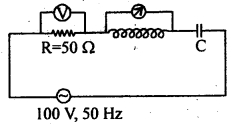
In the series L-C-R circuit, the voltmeter and ammeter readings are:
MCQ Questions for Class 12 Physics Chapter 7 Alternating Current with Answers
(a) V = 100 Volts, I = 2A
(b) V = 100 Volts, I = 5A
(c) V = 1000 Volts, I = 2A
(d) V = 300 Volts, I = 1A

Answer

Answer: (a) V = 100 Volts, I = 2A


Question 19.
The average power dissipation in pure inductance or capacitance is:
(a) \(\frac{1}{2}\) LI²
(b) \(\frac{3}{2}\) CV²
(c) either (a) or (b)
(d) zero

Answer

Answer: (d) zero


Question 20.
Two coils X and Y are connected in series across a 240 V, 50 Hz supply. The resistance of X is 5Ω and inductance of Y is 0.02 H. The power consumed is 3 kW and the power factor is 0.75. The impedance of the circuit is:
(a) 0.144 Ω
(b) 1.44 Ω
(c) 14.4 Ω
(d) 144 Ω

Answer

Answer: (c) 14.4 Ω


Question 21.
A rejector circuit is:
(a) series resonant circuit
(b) parallel resonant circuit
(c) LCR circuit
(d) None of these

Answer

Answer: (b) parallel resonant circuit


Question 22.
Which of the following effects is not shown in alternating current ?
(a) Chemical effect
(b) Magnetic effect
(c) Heating current
(d) All of these

Answer

Answer: (a) Chemical effect


Question 23.
The inductive reactance of an inductor coil of \(\frac{1}{π}\) H at 50 Hz is:
(a) \(\frac{50}{π}\) Ω
(b) \(\frac{π}{50}\) Ω
(c) 100 Ω
(d) 50 Ω

Answer

Answer: (c) 100 Ω


Question 24.
The average value of a cover a complete cycle is:
(a) l0
(b) \(\frac{l_0}{2}\)
(c) \(\frac{l_0}{√2}\)
(d) zero

Answer

Answer: (d) zero


Question 25.
The natural frequency of an L -C-Circuit is equal to :
(a) \(\frac{\sqrt{LC}}{2π}\)
(b) \(\frac{1}{3π\sqrt{LC}}\)
(c) \(\frac{1}{2π}\sqrt{\frac{L}{C}}\)
(d) \(\frac{1}{2π}\sqrt{\frac{C}{L}}\)

Answer

Answer: (b) \(\frac{1}{3π\sqrt{LC}}\)


Question 26.
An electric circuit containing capacitor only suffers:
(a) equal resistance for A.C. and D.C.
(b) Resistance of A.C. > Resistance of D.C.
(c) Resistance for A.C. < Resistance of D.C.
(d) offers infinite resistance for D.C.

Answer

Answer: (d) offers infinite resistance for D.C.


Question 27.
Power factor of an ac circuit is a measure of:
(a) virtual power
(b) power lost in the circuit
(c) mean power
(d) all the above

Answer

Answer: (b) power lost in the circuit


Question 28.
The current through an inductor of 1H is given by I = 3t sin t. The voltage across the inductor of 1 H is:
(a) 3 sin t + 3 cos t
(b) 3 sin t + 3t cos t
(c) 3 cos t + t sin t
(d) 3t cos t + sin t

Answer

Answer: (b) 3 sin t + 3t cos t


Question 29.
In the above problem, the value of the resistance of the coil Y is:
(a) 0.58 Ω
(b) 5.8 Ω
(c) 1.16 Ω
(d) 11.6 Ω

Answer

Answer: (b) 5.8 Ω


Question 30.
In pure inductive circuit current
(a) lags behind emf by π/2
(b) leads the emf by π/2
(c) lags behind emf by π
(d) leads the emf by π

Answer

Answer: (a) lags behind emf by π/2


CBSE Class 12 Physics - MCQ and Online Tests - Unit 6 - Electromagnetic Induction

CBSE Class 12 Physics – MCQ and Online Tests – Unit 6 – Electromagnetic Induction

Every year CBSE conducts board exams for 12th standard. These exams are very competitive to all the students. So our website provides online tests for all the 12th subjects. These tests are also very effective and useful for those who preparing for competitive exams like NEET, JEE, CA etc. It can boost their preparation level and confidence level by attempting these chapter wise online tests.

These online tests are based on latest CBSE Class 12 syllabus. While attempting these our students can identify the weak lessons and continuously practice those lessons for attaining high marks. It also helps to revise the NCERT textbooks thoroughly.


CBSE Class 12 Physics – MCQ and Online Tests – Unit 6 – Electromagnetic Induction

Question 1.
In a uniform magnetic field B, a wire in the form of a semicircle of radius r rotated about the diameter of the circle with angular frequency ‘ω’. The axis of rotation is perpendicular to the field. If the total resistance of the circuit is R the mean power generated per period of rotation is :
(a) \(\frac{Bπr^2ω}{2R}\)
(b) \(\frac{(Bπr^2ω)^2}{8R}\)
(c) \(\frac{(Bπrω)^2}{2R}\)
(d) \(\frac{(Bπrω^2)^2}{8R}\)

Answer

Answer: (b) \(\frac{(Bπr^2ω)^2}{8R}\)


Question 2.
An e and a p are moving parallel to each other in a magnetic field. The magnetic force acting on the p+ is:
(a) 1840 times that on e
(b) less than that of e
(c) same as that of e
(d) slightly more than that of e

Answer

Answer: (c) same as that of e


Question 3.
A transformer is used to light 100 W and 110 V lamp from a 220 V mains. If the main current is 0.5 A. Then the efficiency of the transformer is:
(a) 11%
(b) 50%
(c) 80%
(d) 90%

Answer

Answer: (d) 90%


Question 4.
The magnetic flux (∅) lined with a coil is related to its area (s) as:
(a) ∅ ∝ s
(b) ∅ ∝ s²
(c) ∅ ∝ s1/2
(d) ∅ ∝ s-1/2

Answer

Answer: (a) ∅ ∝ s


Question 5.
The coupling co-efficient of the perfectly coupled coils is:
(a) Zero
(b) 1
(c) slightly more than 1
(d) infinite

Answer

Answer: (b) 1


Question 6.
If the magnetic flux linked with a coil through which a current off ampere is set up is ∅, then the coefficient of self-inductance of the coil is:
(a) \(\frac{l}{∅}\)
(b) \(\frac{∅}{l}\)
(c) ∅l
(d) None of these

Answer

Answer: (b) \(\frac{∅}{l}\)


Question 7.
The magnetic field is parallel to a surface, then the magnetic flux through the surface is :
(a) zero
(b) small but not zero
(c) infinite
(d) large but not infinite

Answer

Answer: (b) small but not zero


Question 8.
The role of inductance is equivalent to:
(a) inertia
(b) force
(c) energy
(d) momentum

Answer

Answer: (a) inertia


Question 9.
The flux linked with a coif at any instant t is given by ∅ = 10t² – 50t + 250. The induced emf at t = 35 is:
(a) 10 V
(b) 190 V
(c) -190 V
(d) -10 V

Answer

Answer: (d) -10 V


Question 10.
In the expression e = –\(\frac{d∅}{dt}\), the -ve sign signifies:
(a) The induced emf is produced only when magnetic flux decreases
(b) The induced emf opposes the change in the magnetic flux
(c) The induced emf is opposite to the direction of the flux
(d) None of these

Answer

Answer: (b) The induced emf opposes the change in the magnetic flux


Question 11.
A metal conductor of length 1 m rotates vertically about one of its ends at angular velocity 5 rad s-1 . If the horizontal component of earth’s magnetism is 2 × 10⁻⁵ T, then e.m.f. developed between the two ends of the conductor is:
(a) 5 µV
(b) 50 µV
(c) 5 mV
(d) 50 mV

Answer

Answer: (a) 5 µV


Question 12.
1 henry is equal to :
(a) \(\frac{weber}{ampere}\)
(b) \(\frac{weber}{Volt}\)
(c) weber ampere
(d) None of these

Answer

Answer: (a) \(\frac{weber}{ampere}\)


Question 13.
The magnetic flux (∅) linked with a coil is related to the number of turns (N) ofthe coil as:
(a) f ∝ N
(b) f ∝ N-1
(c) f ∝ N2
(d) f ∝ N-2

Answer

Answer: (a) f ∝ N


Question 14.
coil of L = 8.4 mH and R = 6 Ω is connected to a 12 V battery. The current in the coil is 1.0 A at approx’time of:
(a) 500 s
(b) 20 s
(c) 35 ms
(d) 1 ms

Answer

Answer: (d) 1 ms


Question 15.
The core of a transformer is laminated because:
(a) rusting of core may be prevented
(b) ratio of voltage in primary and secondary may be increased.
(c) energy losses due to eddy current may be minimised
(d) The weight of transformer may be reduced

Answer

Answer: (c) energy losses due to eddy current may be minimised


Question 16.
If I current is flowing inductance L, then the dimension of \(\frac{3}{2}\) LI² is equivalent to:
(a) charge
(b) force
(c) momentum
(d) energy

Answer

Answer: (c) momentum


Question 17.
A choke is used as a resistance in :
(a) dc circuits
(b) ac circuits
(c) both ac and dc circuits
(d) neither (a) nor (b)

Answer

Answer: (b) ac circuits


Question 18.
For purely capacitive circuits, power factor is:
(a) 0
(b) -1
(c) 1
(d) infinity

Answer

Answer: (a) 0


Question 19.
The magnetic flux linked with a coil is inversely proportional to the?
(a) magnetic field
(b) area of cross section
(c) number of turns
(d) none of these

Answer

Answer: (a) magnetic field


Question 20.
Which of the following is not equal to a henry?
(a) \(\frac{Volt second}{ampere}\)
(b) \(\frac{Volt second^2}{Coulomb}\)
(c) \(\frac{Volt^2 second}{Coulomb}\)
(d) \(\frac{Jole second}{Coulomb^2}\)

Answer

Answer: (c) \(\frac{Volt^2 second}{Coulomb}\)


Question 21.
When the magnetic field is parallel to a surface, then the magnetic flux through the surface is:
(a) infinite
(b) zero
(c) small but not zero
(d) large but not infinite.

Answer

Answer: (b) zero


Question 22.
The phase difference between the flux linkage and the emf in a rotating coil in a uniform magnetic field is:
(a) zero
(b) \(\frac{π}{2}\)
(c) \(\frac{π}{4}\)
(d) π

Answer

Answer: (c) \(\frac{π}{4}\)


Question 23.
The energy stored in a 50 mH inductor carrying a current of 4 A is:
(a) 0.1 J
(b) 0.4 J
(c) 0.04 J
(d) 0.01 J

Answer

Answer: (b) 0.4 J


Question 24.
Two coils of self inductance 2 mil and 8 mil are placed so close together that the effective flux in one coil is completely linked with other. The mutual inductance between these coils is :
(a) 4 mH
(b) 16 mH
(c) 10 mH
(d) 6 mH

Answer

Answer: (c) 10 mH


Question 25.
The SI unit of magnetic flux is:
(a) T
(b) Tn-2
(c) Wb
(d) Wb m-2

Answer

Answer: (c) Wb


Recent Posts

In Article

Total Pageviews